

Make Circularity Real: Introduction
Make Circularity Real is the principle that guides this week’s guest article from global circularity expert Rachel Sheila Kan. Drawing on decades of applied work across fashion systems and regenerative supply chains, Rachel explores how businesses move circular strategy from theory into operational reality.
Circularity is widely discussed in boardrooms, yet discussion rarely delivers change on its own. Many organisations invest in strategy frameworks and ambition statements, only to find that momentum slows when those ideas reach day-to-day operations. The gap between intention and execution is where most initiatives stall.
At Real Circularity, the focus is on practical application. To make circularity real inside an organisation, it must be tested within commercial constraints, supply chain pressures and cultural realities. That testing does not need to begin at scale. A contained pilot, a redesigned product line or a focused supplier experiment can reveal more than months of modelling. Once teams see measurable performance, circularity shifts from theory to something tangible and workable.

Start With Proof
Strong circular systems often begin in smaller ecosystems where iteration is faster and collaboration is closer.
Sanja Stories illustrates this by reconnecting traditional Khadi hand weaving with regenerative indigenous cotton, integrating circular design and Digital Product Passports. Heritage knowledge becomes part of a functioning, transparent system that responds to modern market expectations. Machinery is adapted, fibre systems are tested and improvements are made in response to real outcomes.
When models are proven in contained environments, they provide a foundation for expansion. The same principles can inform larger factory networks and multi-product systems. Scaling becomes a business decision grounded in evidence rather than projection. This steady progression is what allows organisations to make circularity real in ways that stand up commercially.
Get In TouchFind the Acupuncture Points
Circular transformation does not always originate at the executive level. In many businesses, strategic conversations become absorbed by reporting cycles and compliance requirements, slowing tangible progress.
Instead of waiting for a structural overhaul, it is often more effective to locate specific leverage points within the system. These “acupuncture points” may sit within a supplier relationship, a packaging redesign or a resale pilot that has not yet been explored. Focused intervention can create visible improvement without destabilising the wider operation.
When results are measurable and commercially coherent, internal confidence grows. Circularity becomes associated with operational strength rather than risk. Over time, carefully placed actions influence the broader system, helping teams make circularity real through demonstration rather than persuasion.
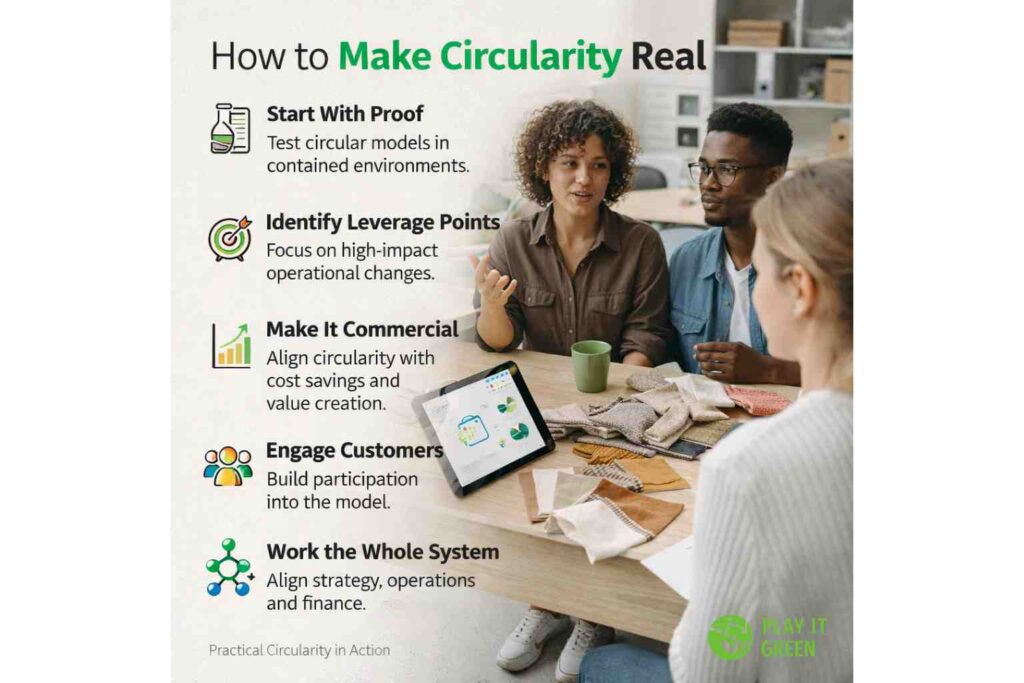
Make It Commercial
Circular systems endure when they reinforce business performance.
Partnerships such as those with The Fashion People enable brands to introduce peer-to-peer reuse technology without building complex internal infrastructure. Existing inventory can generate additional revenue streams, operational strain is reduced and brand identity remains intact. For organisations operating with stable margins, return on investment can begin to appear within short timeframes.
Collaboration with Set Surfaces offers another example. Hybrid virtual photoshoots using real models within digitally supported environments reduce logistical waste and lower production costs. Circular thinking strengthens efficiency when embedded into operations rather than layered on top. Embedding these practices into daily processes helps organisations make circularity real through improved performance.

Engage the Customer
No circular model succeeds without customer participation. Resale, repair and slower production cycles rely on behaviour as much as design.
Younger audiences have embraced reuse and resale, yet long-term resilience depends on engagement across generations. Brands that cultivate genuine community, whether through membership structures, digital platforms or direct communication channels, create conditions where circular behaviour feels intuitive rather than imposed.
Payment design also influences participation. Allowing customers to spread cost over time supports pre-order systems and slower fashion cycles. In these models, the narrative behind a product strengthens trust and connection. When customers understand how their participation contributes to longevity and impact, businesses are better positioned to make circularity real in ways that sustain commercial viability.

Work the Whole System
Circularity cannot be resolved through isolated product adjustments. It requires alignment between strategy, culture, operations and financial objectives.
Reports and frameworks provide direction, yet they do not substitute for experimentation. Progress accelerates when organisations identify where circular design creates value, test interventions within operational limits and measure outcomes honestly. Phased transition, grounded in commercial logic and evidence, builds durability into change.
The path forward begins with focused action, measurable outcomes and disciplined expansion.
That is how businesses make circularity real.
About Rachel Sheila Kan
Rachel Sheila Kan is a global circularity expert and founder of Real Circularity. She works with brands, factories and industry bodies to test circular models in real-world conditions and build commercially grounded transition strategies.
Website: https://realcircularity.com/
Book a strategy conversation: https://bookus.page/Simple/Rachel
If you enjoyed this guest article on how to Make Circularity Real, why not become part of a community creating positive change by partnering with Play It Green?
We help you reduce your footprint, repair the planet, and regive to social causes that matter, all through simple, measurable actions that fit your business.

Modern employees, consumers, and investors want to see impact, not promises. With Play It Green, your sustainability journey becomes visible, credible, and rewarding.
Join us today and turn good intentions into lasting results.
Sign Up