

New UK Sustainability Reporting Rules Introduction
New UK Sustainability Reporting Rules are coming, and the way some companies report is about to change. From accounting periods beginning on 1 January 2027, ‘in-scope’ listed companies will move to a regime based on the new UK Sustainability Reporting Rules, known as UK SRS S1 and S2.
Most SMEs are not directly covered by these FCA (Financial Conduct Authority) rules, but the change is still relevant because larger organisations increasingly need reliable information from across their value chains, especially when they assess Scope 3 emissions and sustainability-related risks.
For smaller businesses supplying larger organisations, the practical question is therefore not whether they suddenly have a new legal reporting duty, but whether customers may begin asking for better information about emissions, energy use, environmental performance and the evidence behind sustainability claims.

What is changing?
The Government published the final UK Sustainability Reporting Standards in February 2026. S1 sets the overall framework for sustainability-related financial disclosures, while S2 focuses specifically on climate-related risks and opportunities.
On 30 September, the Financial Conduct Authority confirmed that in-scope listed companies will use UK SRS on a comply-or-explain basis for accounting periods starting on or after 1 January 2027, with the first reporting under the new regime expected in 2028. The FCA has also allowed transitional relief, including one year for Scope 3 emissions disclosures and two years for wider sustainability disclosures under S1, recognising that reliable sustainability data takes time to build.
Why should smaller businesses pay attention?
The new rules do not create an automatic reporting duty for most SMEs, but they could still influence the information larger customers expect from suppliers. Scope 3 emissions can include purchased goods and services, transport, business travel and other value-chain activity, so some organisations will need better information from the businesses they buy from.
Being able to provide that information clearly can make tendering, procurement reviews and customer conversations easier. It can also help a business understand its own costs, risks and opportunities rather than treating sustainability simply as something to report externally.
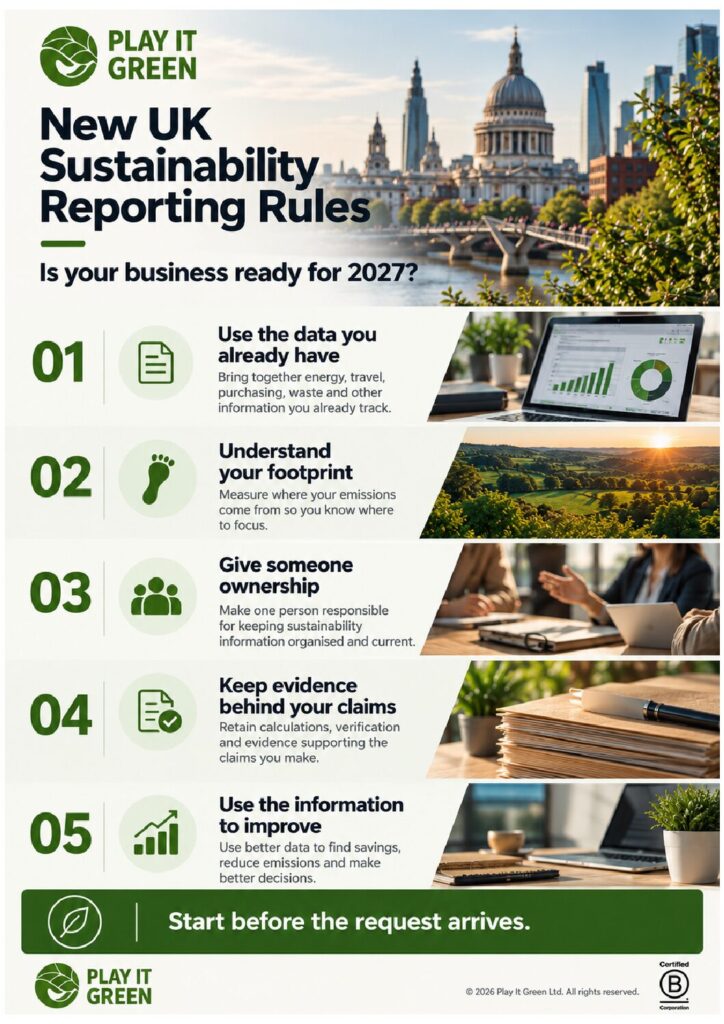
Five practical steps to take now
1. Find out what data you already have.
When it comes to the new UK Sustainability Reporting Rules, it makes sense to start with information that already exists across the business, including energy bills, fuel use, travel, purchasing, waste and logistics records. In many cases, the first task is organising existing information properly rather than creating something completely new.
2. Understand your footprint.
A measured organisational footprint gives you a baseline and shows where emissions are coming from. Scope 1 covers direct emissions, Scope 2 covers purchased energy and Scope 3 looks at indirect emissions across the wider value chain. You do not need perfect data on day one, but you do need a clear view of the biggest areas of impact and where better information is required.
3. Give someone ownership.
Sustainability information often sits across finance, operations, HR, procurement and facilities. Giving one person responsibility for coordinating it, agreeing where evidence is stored and keeping it current can remove a lot of friction when a customer, tender or investor asks for information at short notice.
4. Keep evidence behind your claims.
If you say emissions have fallen, retain the calculation. If you support nature repair, keep the verification. If you make claims about renewable energy, recycling or social impact, make sure the supporting evidence can be found. The direction of sustainability reporting is towards information that people can understand, compare and trust.
5. Use the information to improve the business.
The new UK Sustainability Reporting Rules should support better decisions, not simply create more paperwork. Energy data can uncover avoidable costs, supplier information can highlight risk, and a measured footprint can show where reduction efforts will have the greatest effect. The FCA’s sustainability reporting guidance makes the same broader point: reliable sustainability information is valuable because it helps investors, banks and insurers understand risk and make decisions.

New UK Sustainability Reporting Rules: Wrap Up
As the new UK Sustainability Reporting Rules focus on larger businesses, there is no need for SMEs to treat January 2027 as a new compliance deadline, but there is a strong case for being prepared. Businesses that understand their footprint, improve the information they hold, reduce emissions where practical and keep credible evidence will be better placed when customers, procurement teams or investors ask for it.
At Play It Green, we help businesses engage and educate their people, access expert support to measure their footprint, reduce it through education, signposting and specialist partners, and create verified nature repair and social impact alongside that reduction journey. Preparing now means less scrambling later and gives businesses sustainability information they can actually use.