

SME ESG Strategy: Introduction
An SME ESG strategy should make business clearer, not bury people under a document nobody reads. Many smaller businesses hear about ESG, climate reporting, supply chain data, carbon footprints, customer expectations and regulation, then assume the answer must be a huge strategy document.
A better route is a short, practical plan that links sustainability to cost, risk, customers, staff and proof. Larger firms are already pushing suppliers for better data, and smaller businesses do not need to panic, but they do need to get organised.

The Problem with Big ESG Plans
A 90-page ESG document can look impressive; however, the problem is what happens next.
In many SMEs, it creates a delay. A senior person asks for a serious strategy, the job becomes too large, nobody owns the next step, and the business ends up with a long file rather than better decisions.
Good sustainability work often starts with banking, energy bills, waste contracts, travel habits, supplier choices, staff behaviour and customer questions. That is why an SME ESG strategy needs to be practical from day one.
If it does not help the business make decisions, win work, reduce waste, answer client questions or show credible action, it is probably simply theatre with a table of contents. Research from the British Business Bank has shown that SMEs are responsible for a large share of UK business emissions, with many already taking net zero action. The gap now is structure, as lots of firms are doing useful things, but the work is scattered or unmeasured.
What a Useful SME ESG Strategy Should Do
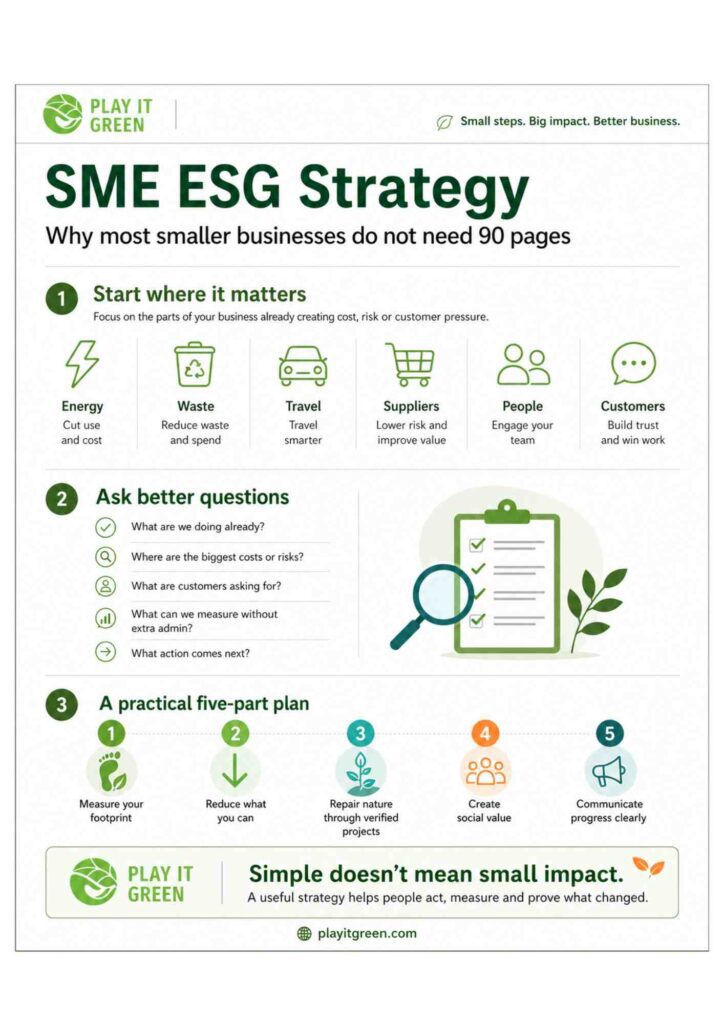
A useful SME ESG strategy should answer plain questions.
- What are we doing now?
- Where are the highest costs, risks or emissions?
- What are customers, staff, suppliers or funders asking for?
- What can we measure without creating a reporting monster?
- What will we do this year?
That is enough to start. A small business does not need a consultancy-style masterpiece before it changes energy habits, reviews suppliers, cuts waste, tracks travel or supports verified nature repair.
The business case starts in normal operations: Lower energy use saves money, better supplier choices reduce risk, clear reporting helps with tenders, and staff engagement improves when people see useful action rather than vague claims.
Start Where the Pressure Already Exists
The best SME ESG strategy begins with the parts of the business already causing cost, friction or customer pressure.
For hospitality, that may mean energy, food waste, packaging, staff retention and guest communication. For professional services, it may mean travel, office energy, procurement, digital habits and client reporting. For parks, marinas or venues, it may mean bookings, supply chains, waste, biodiversity and transport.
This stops the plan from becoming theoretical and makes sustainability part of everyday decisions rather than a side project owned by one tired person with too many plates spinning.
There is one real caution, however, as simple cannot mean vague. If you claim carbon reduction, show the data, if you talk about nature repair, show where it happened; and if customers helped fund action, explain the mechanism.
The Five-Part Plan
A practical SME ESG strategy can sit across five areas.
Start with footprint: Measure what you can, beginning with energy, travel, waste, water and supplier spend.
Move to reduction: Pick actions that cut waste and cost, such as heating controls, supplier changes, reduced travel or stock planning.
Add nature repair: This gives the business a positive route alongside reduction, especially when projects are verified and easy to explain.
Build in social value: Sustainability works better when it creates wider benefit, whether through charity support, community investment, staff volunteering or customer-led giving.
Communicate with care. Use plain language, clear numbers and honest limits. Say what has been done, what is next, and what still needs work.
Get In TouchWhere Play It Green Fits
For many SMEs, the missing link is not goodwill, it is time, structure and confidence. Play It Green gives businesses a simple route through our three pillars of reduce, repair and regive.
That includes weekly education, practical guidance, verified nature repair, impact reporting and social value through the 10% giving model. It gives an SME ESG strategy a clear spine without turning it into an admin swamp.
The point is not to look perfect, but rather it is to act, measure and communicate honestly.

SME ESG strategy: Wrap-Up
An SME ESG strategy does not need to be 90 pages long.
A useful plan should be clear enough for the team to use, grounded enough for customers to trust, and commercial enough for leadership to care. It should reduce waste, cut risk, support sales, engage staff and create proof.
The businesses that gain most will not be the ones with the longest documents. They will be the ones that turn sustainability into practical action, then back it up with evidence.
Strategy only matters when it changes what happens next.
If you enjoyed this article on SME ESG Strategy, why not become part of a community creating positive change by partnering with Play It Green and receive these tips weekly straight to your inbox?
We help you reduce your footprint, repair the planet, and regive to social causes that matter, all through simple, measurable actions that fit your business.

Modern employees, consumers, and investors want to see impact, not promises. With Play It Green, your sustainability journey becomes visible, credible, and rewarding.
Join us today and turn good intentions into lasting results.
Sign Up