
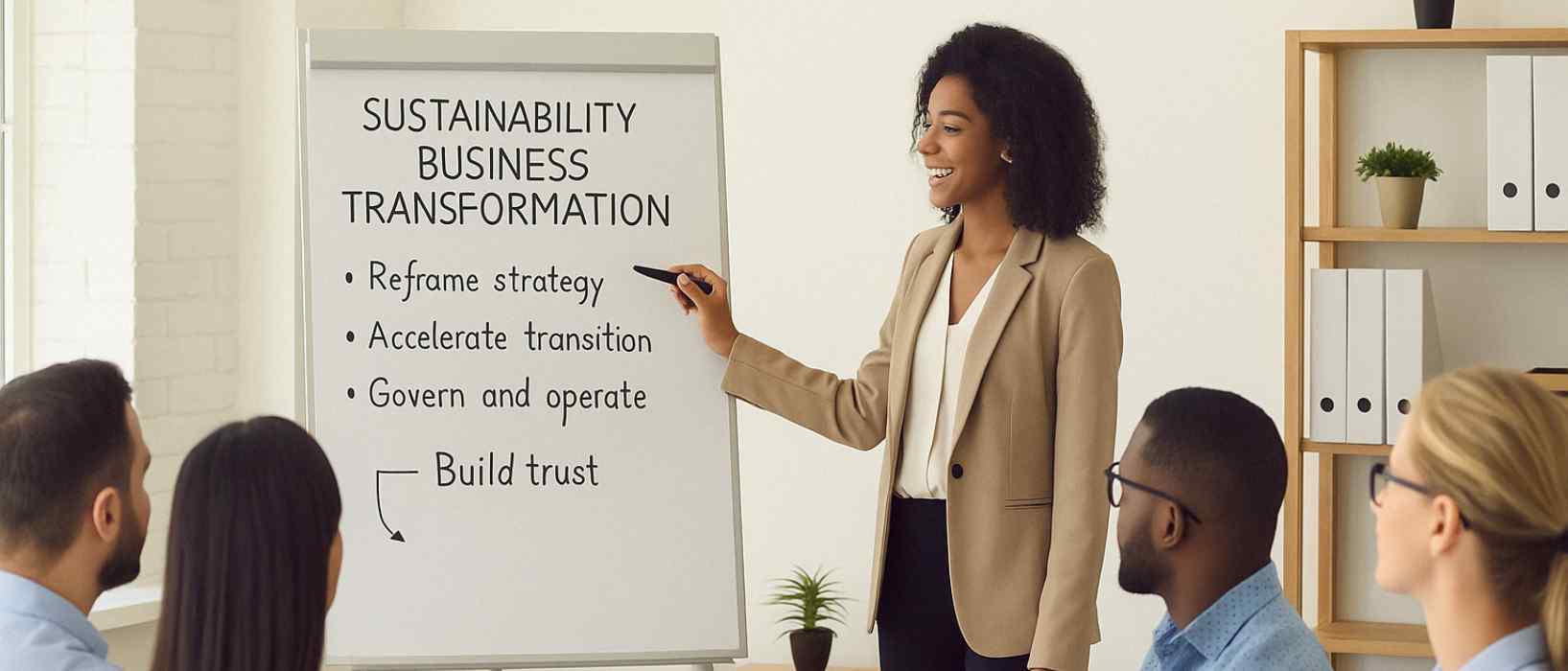
Sustainability Business Transformation: Introduction
Sustainability business transformation means aligning what you do with what the world actually needs. When it’s done well, it creates real value: financial, social, and environmental. This isn’t ticking boxes. It’s about weaving sustainability into the way your business thinks, acts, and shows up.
Here’s an easy-to-follow guide to doing it right. Four clear phases: reframe your strategy, accelerate the transition, govern how you operate, and build trust. Most businesses skip a step or rush the process. You don’t need to. Get these four right and you’ll build something that lasts.

Phase 1: Reframe Strategy
Real transformation starts with looking at your strategy through a different lens. What ESG trends are affecting your sector? What do your customers and employees actually care about? If you don’t know, ask. Then act.
Forget the vague mission statements. Align your strategy with what matters. Use double materiality to map impact both ways – how sustainability affects your business and how your business affects everything else.
While you’re at it, review your leadership goals. Still thinking in quarterly targets? You’re already behind. Get clear on what long-term value really looks like, then update your KPIs to match.
This is the time to bring in proper stakeholder mapping. Don’t just list your investors and regulators. Include your supply chain, communities, and even future generations. What you measure shapes what you value. So check your values.
And don’t overlook the value of scenario planning. Looking ahead at likely climate, social, or regulatory shifts helps futureproof your business while showing your board that you’re not just reacting to headlines. This is the way to start your sustainability business transformation!
Ask A QuestionPhase 2: Accelerate Transition
Having a decent strategy is one thing. Acting on it is where most businesses struggle. Transition needs speed, and it needs teeth. That means the CFO is just as involved as your sustainability team.
Set a proper budget for sustainable innovation. Link bonuses to outcomes that matter. Update contracts. Set science-based targets. Don’t say you’re sustainable if you’re still funding the opposite.
This is the moment to embed ESG into your real processes – finance, procurement, risk, product, ops. Make sustainability part of every job, not just someone else’s.
Bring your teams in early. Start with pilots, get feedback, learn fast. Big change is just lots of small changes, done deliberately. Keep it moving and mark the wins.
Create space for experiments. Not everything will work the first time. But visibility over what’s tried and what’s learned keeps momentum going. It also builds credibility when you share lessons as well as wins.

Phase 3: Govern and Operate
This is the unglamorous bit – but it’s where it all comes together. Governance is how your strategy shows up in everyday decisions. It means having the right structures, clear roles, and accountability.
Get ESG onto your board agenda. Don’t hand it to someone buried under spreadsheets. Track your carbon, diversity, and labour standards, and make it part of your business dashboard.
People need to know how this fits their job. That means training, targets, and systems that reward the right behaviour. Set up ways to raise issues and actually listen.
Ditch the vanity metrics. Focus on real progress. No more glossy PDFs with nothing behind them. Your team should be able to see what’s working and fix what isn’t.
And review your reporting rhythms. Is sustainability something you talk about once a year? Or is it part of every ops meeting, team huddle, and leadership check-in? If it matters, it’s weekly. Doing this will keep you on track for your sustainability business transformation!

Phase 4: Build Trust
You don’t build trust with slogans. Internally, your people want to see steady action. Externally, people want facts and honesty, not spin.
Say what you’re doing. Share your data. Be upfront about where you’re falling short. If you’re trying, say so. If you’ve messed up, own it.
Trust makes or breaks your reputation. It also keeps your people, customers, and investors on side. Done right, it gives you staying power.
Encourage feedback. Make it easy for people to engage. Let others challenge you. If you’re open about the process, more people will want to support it.
And don’t forget your suppliers. If you squeeze them while talking about ethics, it won’t take long for that to surface. Treat them like partners.
Make it human. Show faces. Tell stories. Trust isn’t built through graphs alone – it’s built through relationships.

Sustainability Business Transformation: Wrap Up
Sustainability business transformation is not a marketing slogan. It’s a shift in how you work, why you do it, and who gains.
Reframe your strategy so it actually reflects what matters. Take action quickly, not perfectly. Govern with clarity and integrity. And build trust by being open and consistent.
If you do all that, you’ll be sustainable by default – and a better business all round.
Let’s get on with it.
Embrace a Sustainability Business Transformation with Play It Green
By partnering with Play It Green, you can integrate sustainable action, education, tree planting, mangrove restoration, seaforestation and social impact into your business operations. Whether it’s adding nature repair to your sales process, engaging employees, or strengthening your environmental credentials, the tools and support are there to make it simple.
Every action contributes to restoring the planet.
Sign UpWant more info before deciding? Click here.