

Sustainability in Tenders: Introduction
Sustainability in tenders has moved much closer to the commercial heart of winning work, with buyers increasingly asking suppliers to prove how they manage carbon, people, supply chains and wider social value.
For businesses, that can create an opportunity rather than another layer of paperwork, since a company with credible evidence can compete on far more than price and company size. The key is being ready before the tender arrives, with useful data, records and examples already in place.

Procurement Has Changed
Public procurement rules have changed significantly, and that is important to businesses looking for public contracts or work further down public-sector supply chains. The Procurement Act 2023 supplier guidance explains the changes that took effect in February 2025, with one stated aim being to open public contracts to smaller businesses and social enterprises.
Central government policy goes further on social value. Under PPN 002 and the Social Value Model, relevant procurements must apply a minimum 10% weighting to social value, or an equivalent measure under another scoring method. That means environmental and social evidence can influence scoring, rather than sitting in a corporate responsibility document that few people read.
Some Evidence Can Affect Qualification
For major central government contracts, carbon information can appear even earlier in the process. PPN 006 on Carbon Reduction Plans applies to relevant central government procurements above £5 million per year, including VAT. Bidding suppliers can be required to submit a Carbon Reduction Plan confirming a commitment to UK net zero by 2050.
Most SMEs will not be bidding alone for a £5 million annual government contract, yet the direction is still important since larger organisations often need supplier data to support carbon plans, reporting and procurement requirements. A smaller supplier with organised environmental data can make life easier for a larger customer, and being easy to buy from can become a genuine commercial advantage.
Get In TouchEvidence Beats Broad Claims
For sustainability in tenders, one of the most useful points in the Government’s Social Value Model guidance is that assessment should focus on what a supplier will deliver through the contract rather than relying on broad corporate policies. Writing that your business “cares about sustainability” gives a buyer very little to score, but showing a measured footprint, reduction activity, supplier changes, employee engagement or a defined community commitment gives the evaluator something far stronger.
The same principle applies to nature and social impact, where verified nature repair or measurable community activity can strengthen a response when they connect clearly to the buyer’s aims. These actions should sit alongside genuine reduction work, with records showing what happened, what changed and what result was achieved.
Build an Evidence Bank Before the Tender Lands
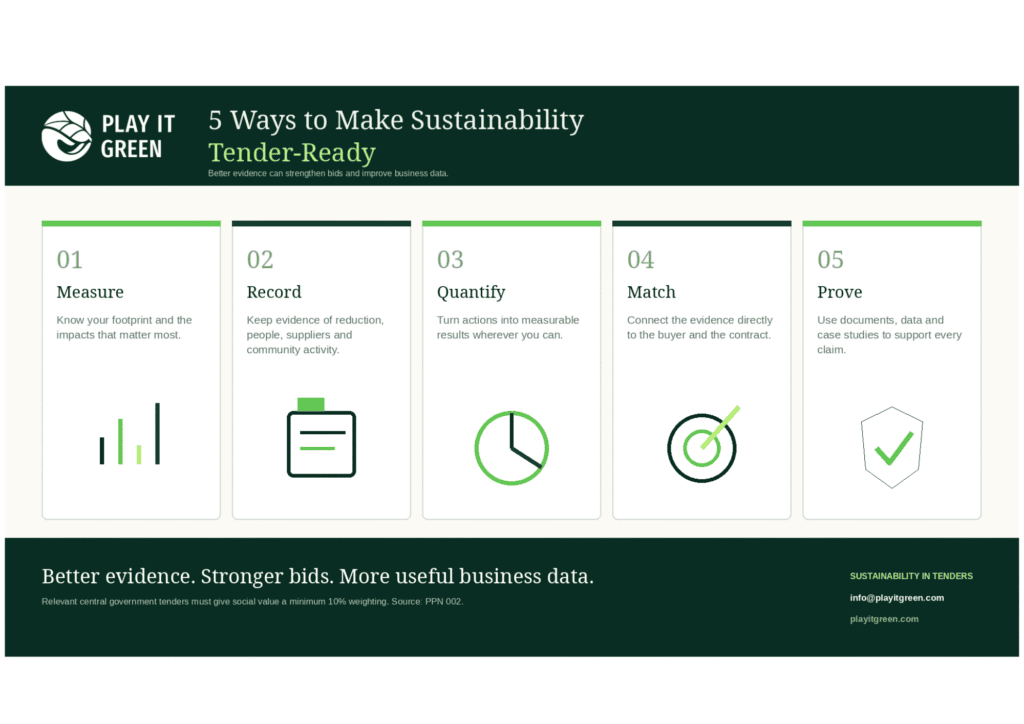
The worst time to gather evidence of sustainability in tenders is two days before a deadline, since rushed bids often produce vague answers, missing data and commitments that nobody has properly checked. A tender-ready business can keep an evidence bank covering its footprint, reduction work, policies, supplier standards, staff involvement, nature activity and measurable social outcomes.
It helps to turn activity into numbers, so energy saved, emissions reduced, staff trained, money given to good causes or verified nature outcomes can give a buyer clearer evidence than broad statements. Case studies can strengthen this further when they show the problem, the action taken and a measurable result, giving the buyer proof that the business has already delivered similar work.
Make Every Answer Relevant
Copying the same sustainability paragraph when working on sustainability in tenders can save time and lose points, since buyers are usually looking for commitments connected to the work they are buying. A hospitality contract might focus on food waste, local employment and supply chains, whereas a transport tender may give more weight to fleet emissions, fuel and routing. The strongest response starts with the buyer’s outcome and then uses evidence that directly supports it.
The Social Value Model follows that same principle, with outcomes and award criteria expected to relate to the contract and remain proportionate to what is being purchased. That makes relevance just as valuable as volume, since two pages that answer the buyer’s question clearly can carry far more weight than ten pages of unrelated environmental activity.
The Value Goes Beyond One Bid
Preparing evidence for sustinability in tenders can improve far more than tender responses, since the same information can support customer conversations, supplier reviews, recruitment, investor discussions and internal planning. A business that knows its impacts and can show credible progress has a stronger proposition, particularly when competitors are still relying on broad statements that are difficult to prove.
The process can reveal savings and risks too, with carbon measurement exposing unnecessary energy or travel, and supplier reviews highlighting hidden issues. Over time, that creates a stronger commercial foundation, since the business becomes faster at answering customer questions and more confident about public claims.

Sustainability in Tenders: Wrap-Up
Sustainability in tenders is becoming another place where good business practice and commercial opportunity meet, with buyers increasingly asking for proof that suppliers can deliver value without ignoring environmental and social impact. For SMEs, the sensible approach is to prepare evidence before it is requested, connect commitments to the contract and record results that can be verified.
That can strengthen tender responses today and create wider value over time, with better data supporting customers, risk, recruitment and planning. A company that can prove what it does has far more to work with than one that simply says the right things.
Create Commercial Value with Play It Green
Play It Green helps businesses make sustainability practical, measurable and commercially sensible.
Our members learn through simple weekly education like this article, Sustainability in Tenders, reduce their footprint with support and expert signposting, repair nature across land, coast and sea, and create social impact through our 10% revenue giveback to good causes.

That gives your business credible action you can share with employees, customers and other stakeholders, backed by transparent reporting and measurable impact.
If you want to cut costs, reduce risk, attract great people and build stronger customer loyalty through sustainability, including measurement and reduction, nature repair and social impact, speak to Play It Green.
Find Out More