

Sustainability Innovations of 2026: Introduction
This week, we’re doing something a little different, and instead of corporate news, we are looking at our top three Sustainability Innovations of 2026. These innovations could genuinely improve how buildings manage heat, how cities treat water and how we generate power. Rather than corporate pledges or regulatory shifts, this edition focuses on engineering and infrastructure.
Our Sustainability Innovations of 2026 are at different stages of maturity, yet each one addresses a major system challenge.

Wood–Clay Thermal Batteries
The first of our Sustainability Innovations of 2026 is a material designed to store heat inside walls and panels. Researchers at Aalto University in Finland have developed a porous composite made from spruce-waste biochar and montmorillonite clay, infused with a paraffin phase-change material called hexadecane. The paraffin absorbs heat as it melts and releases it as it solidifies. The wood–clay structure holds the liquid in place and improves thermal conductivity, allowing faster heat movement.
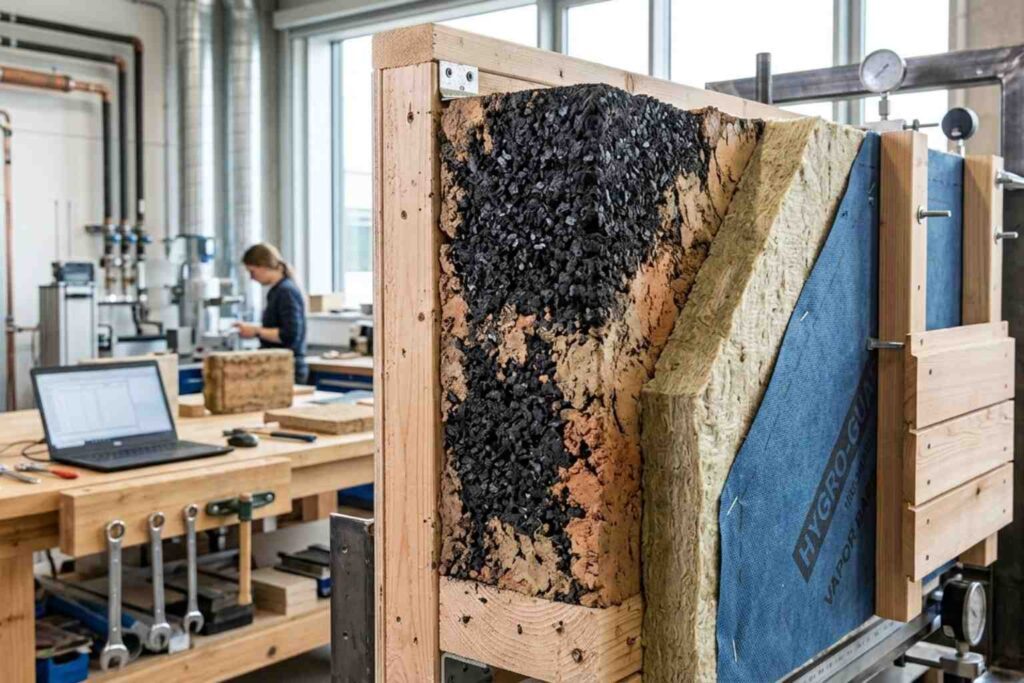
Heating and cooling account for roughly 30 per cent of global energy demand. Improving passive thermal stability in buildings could reduce peak loads on HVAC systems and lower installed capacity requirements. Unlike many high-performance phase-change materials, this approach replaces fossil-derived carbons such as graphene with waste wood biochar and natural clay.
The research remains at laboratory scale. Long-term cycling stability, fire safety, and manufacturability at panel scale still need testing. A synthetic surfactant is used in production and must be replaced with a lower-impact alternative. If these hurdles are resolved, retrofittable interior panels could flatten temperature swings in offices, warehouses and data centres without major system upgrades.
Get In TouchNature-Inspired Wastewater Treatment
The second entry in our Sustainability Innovations of 2026 focuses on decentralised wastewater systems.
Organica Water has developed compact treatment plants that combine plant-root ecosystems and microbial biofilms within engineered tanks. The systems mimic wetland processes but operate inside controlled, covered reactors suitable for dense urban settings. Compared with conventional plants, they require around 60 per cent less land and roughly 30 per cent less energy.

In South and Southeast Asia, more than 80 per cent of wastewater is discharged untreated. Large centralised plants demand land and extensive sewer networks, which slow deployment. Smaller modular systems can be built closer to the point of generation, reducing pumping energy and enabling phased expansion.
This technology is already commercial, with installations in multiple countries. Performance depends on operator capability and local regulatory standards for reclaimed water. Strong management and oversight remain essential to maintain trust. For urban regeneration projects and industrial estates, these systems offer resilience, water security and biodiversity value within a single infrastructure asset.
Semi-Transparent 3D-Printed Solar Cells
The third of the Sustainability Innovations of 2026 selections brings energy generation into the building envelope.
Researchers at the Hebrew University of Jerusalem have developed a flexible, semi-transparent perovskite solar cell that allows colour and transparency to be tuned through microscopic 3D-printed polymer pillar arrays. The geometry of these pillars controls how light passes through the device and which wavelengths are reflected.

Laboratory testing achieved power conversion efficiencies of up to 9.2 per cent with around 35 per cent visible transparency. The cells remained stable under repeated bending in controlled conditions. The process avoids high-temperature manufacturing and toxic solvents, which may support lower-impact production.
Most urban surface area consists of glass façades and windows. Traditional photovoltaic panels are opaque and mainly suited to rooftops. These devices target building-integrated photovoltaics, turning façades and curved surfaces into potential generators without eliminating natural light.
Durability under moisture, UV exposure and heat remains a central challenge for perovskites. Regulatory approvals for glazing products will extend timelines before widespread adoption. Even so, integrating generation directly into architectural elements could expand solar deployment beyond current physical constraints.

Sustainability Innovations of 2026: Wrap-Up
The Sustainability Innovations of 2026 highlight a pattern that feels important. Progress increasingly comes from redesigning systems rather than adding compensating layers. Materials that store heat reduce mechanical demand, living wastewater systems cut land and energy requirements and solar technologies move generation into surfaces that already exist.
At Play It Green, our community works on similar principles. Long-term impact must align with performance, economics and practicality. Not every innovation will scale and some will take years to mature. Yet the direction of travel is clear: Infrastructure is becoming smarter, more distributed and more integrated.
That is where durable change usually begins.
If you enjoyed the Sustainability Innovations of 2026, why not become part of a community creating positive change by partnering with Play It Green?
We help you reduce your footprint, repair the planet, and regive to social causes that matter, all through simple, measurable actions that fit your business.

Modern employees, consumers, and investors want to see impact, not promises. With Play It Green, your sustainability journey becomes visible, credible, and rewarding.
Join us today and turn good intentions into lasting results.
Sign Up