

Sustainability News for April 21st: Introduction
The sustainability News for April 21st flips the script on your usual headlines. While mainstream media feeds us fear and failure, we focus on progress, creativity, and the people making things better. This week, we look at roads that repair themselves using AI, tyres crafted from birch bark, and compostable packaging grown from coffee waste and mushrooms.
At Play It Green, we celebrate these solutions because inspiration matters. When we share what works, more people feel empowered to take action. That is how real change begins.

AI Helps Roads Heal Themselves
Potholes are more than a nuisance. They cost UK drivers millions and contribute to carbon emissions from repeated roadworks. But researchers from Swansea University and King’s College London might have a solution. Alongside partners in Chile, they have developed a new type of self-healing asphalt using AI and recycled oils.

The process starts with machine learning, which helped the team understand how bitumen hardens and cracks over time. Bitumen is the sticky component in asphalt that oxidises and becomes brittle. Researchers then created tiny porous capsules, or spores, filled with recycled oil. When cracks form, these spores burst open and release the oil, softening the bitumen and sealing the crack.
In lab tests, the material healed a microcrack within an hour. The research is ongoing, with hopes to integrate sustainable ingredients like biomass to further reduce environmental impact. If successful, this technology could reduce both carbon emissions and repair costs. It may even improve road safety. The promise of roads that mend themselves without human intervention feels futuristic, but it could soon become reality. One less pothole might not change the world, but millions of them just might.
Get In TouchBirch Bark Tyres Offer a Greener Grip
Rubber tyres are everywhere, but they come at a cost. Natural rubber leads to deforestation, while synthetic rubber relies on fossil fuels. A Swedish startup called Reselo has found a surprising solution: turning birch bark waste into a bio-based rubber alternative. This breakthrough could transform one of the automotive industry’s most polluting products.
Reselo collects discarded birch bark from the paper and pulp industry. Instead of burning or dumping it, they process it into a material called Reselo Rubber. Unlike most bioplastics, this substance has polymerisation capability, making it strong enough to replace fossil-based rubber entirely.

Early tests show a carbon reduction of up to 92 percent compared to traditional materials. Even better, the material works with existing tyre manufacturing systems. Reselo is now partnering with Nokian Tyres to test its performance in real driving conditions.
The potential for impact is enormous. Tyres are used in more than just vehicles — from footwear to industrial equipment. A bio-based option that performs like synthetic rubber, but without the emissions, could reshape multiple industries. This is more than a clever use of waste. It is a chance to replace harmful materials with something far more sustainable, without compromising on quality or performance.

Coffee Waste Becomes Compostable Packaging
Every year, the world produces over 60 million tonnes of spent coffee grounds. Most of it ends up in landfill, releasing methane and wasting valuable nutrients. But one doctoral student at the University of Washington saw something different in that waste. Danli Luo has developed a plastic-free packaging alternative made from coffee and mushrooms.
The team combined coffee grounds with rice flour, Reishi mushroom spores, xanthan gum, and water to create a paste called Mycofluid. They then used a customised 3D printer to shape the paste into packaging and other objects. As the mushrooms grew, they formed a tough mycelial skin that retained the shape of the item.
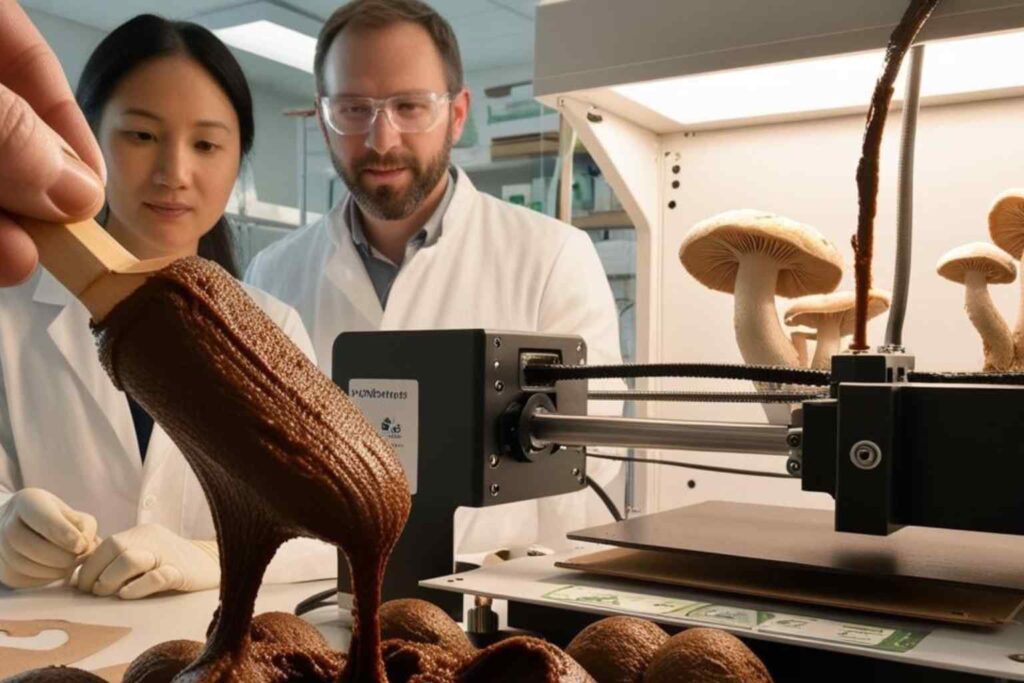
After drying, the material had a density similar to cardboard but with the strength of polystyrene. It is fully compostable and made entirely from waste. More intricate objects can be built by printing smaller pieces and fusing them together with more mycelium.
The mixture must remain uniform, which presents scaling challenges. But the project opens doors to repurposing other food waste streams. It’s a clever, circular idea that turns morning coffee into tomorrow’s packaging. Instead of binning the waste, this approach builds with it. That’s not just smart, it’s sustainable design at its best.

Sustainability News for April 21st: Wrap-Up
Sustainability News for April 21st proves that real change often begins with simple questions. What if roads could heal? What if waste could work harder? What if tyres grew from trees? These answers are not just wishful thinking. They are being researched, tested, and built right now.
The Play It Green community thrives on this kind of thinking, practical, positive, and always looking for better ways forward. Together, we are proving that the future is not waiting. We are creating it, every single day.
Make Positive Sustainability News of Your Own!
If you like the Sustainability News for April 21st, make news of your own, by partnering with Play It Green. You can integrate sustainable action, education, tree planting, mangrove restoration, seaforestation and social impact into your business operations. Whether it’s adding nature repair to your sales process, engaging employees, or strengthening your environmental credentials, the tools and support are there to make it simple. Because, why make it hard!
Sign Up