

Sustainable Raincoats: Introduction
Sustainable Raincoats are a sensible idea in April, when the sky can flip from hopeful to hostile before you have found your keys. April showers may sound rather charming, but that is only until they hit sideways on a school run or dog walk, which is why we always need a raincoat.
Most raincoats look innocent enough, yet many are made from plastic-based fabrics, coated with stubborn damaging chemicals, and replaced far too quickly. A better one should keep you dry for years, not one season and a tragic zip failure, which is where this week’s tip comes in.

A Brief History of Non-Sustainable Raincoats
People have been trying to stay dry for thousands of years. Early civilisations used animal skins, woven grasses and heavy cloaks to keep out rain, long before anyone had the luxury of calling it outerwear. In parts of South America, Indigenous communities waterproofed fabrics with natural latex, whilst in China and Japan, oiled paper and straw rain capes were used for centuries. Britain, being Britain, had every reason to admire all of this from a very wet distance.

The modern raincoat took a huge step forward in 1823, when Scottish chemist Charles Macintosh patented a method of bonding cloth with rubber dissolved in coal tar naphtha. His invention was so influential that Mackintosh became a generic word for a raincoat, which is a decent legacy for a man trying to stop people feeling damp and miserable.
Early versions were far from perfect, and they could stiffen in the cold and turn sticky in warmer weather, so comfort was not always part of the package. Later improvements in rubber treatment and textile production made rainwear more flexible, wearable and affordable and by the twentieth century, raincoats had moved from specialist protection into daily life. This makes their shift into short-lived fast fashion all the more frustrating.
Get In TouchThe Environmental Impact of Non-Sustainable Raincoats
Many traditional raincoats are made from polyester or nylon, which means fossil fuels sit at the heart of the product before the rain has even started. In fact, UNEP says the fashion and textiles sector accounts for 2 to 8 per cent of global greenhouse gas emissions, uses water equal to 86 million Olympic-sized swimming pools a year, and is responsible for 9 per cent of microplastic pollution reaching the oceans annually. That is a hefty impact for something most people buy as a practical seasonal extra that spends six months a year in a cupboard.
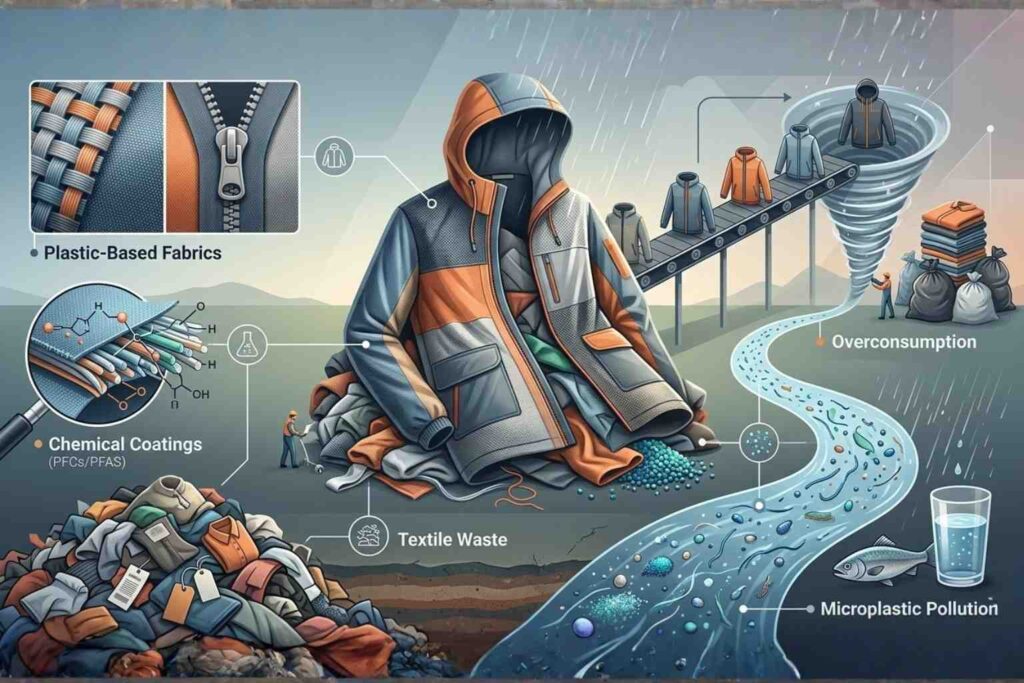
Waste makes the picture worse, and UNEP says the world produces 92 million tonnes of textile waste every year. This is an even bigger problem as garment use fell by 36 per cent even as production doubled between 2000 and 2015. Raincoats can add another problem through waterproof treatments, which are coming under more and more scrutiny. The European Environment Agency also says textiles are one of the biggest sources of PFAS (forever chemicals) pollution in Europe. These chemicals are used to create a waterproof layer on your raincoat, leaving you dry on the outside and murky in the supply chain.
What to Look For in Sustainable Raincoats
A sustainable raincoat needs to do three things well. It needs to keep the weather out, hold up over time, and avoid the worst material and chemical choices hidden in a lot of mainstream outerwear. That starts with the fabric. Look at fabrics like recycled polyester, which is usually a better option than virgin polyester, since it makes use of existing material rather than demanding more fossil fuel extraction. Organic cotton can be a good choice too, especially for lighter raincoats, though the real value comes from how the whole jacket is made rather than the fibre alone.
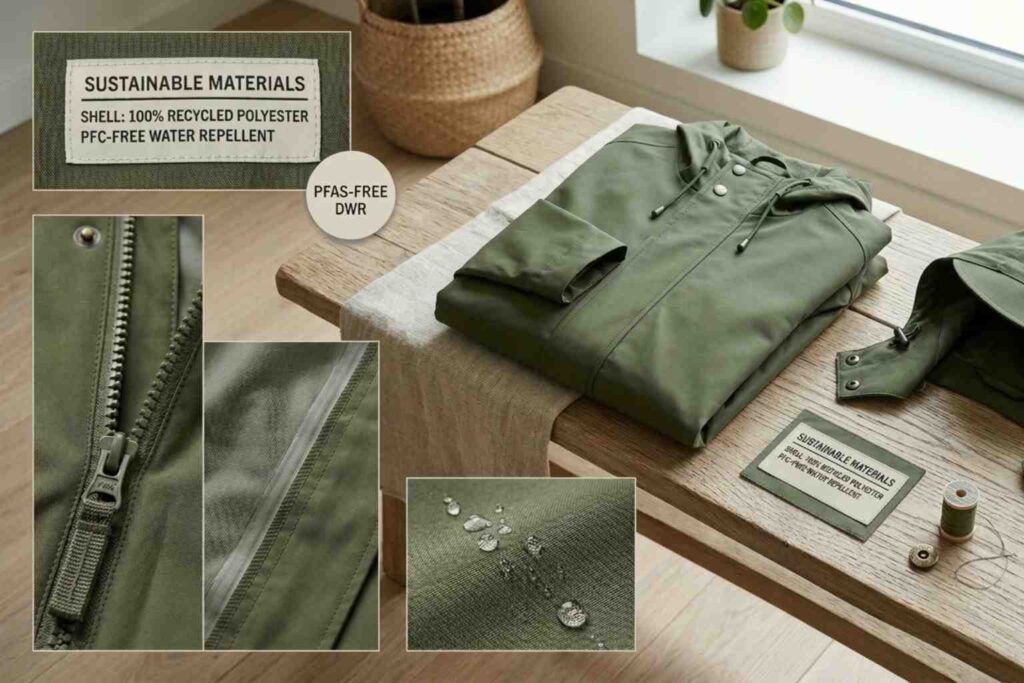
Waterproofing matters just as much as the outer material as many conventional raincoats rely on PFAS or PFC-based finishes to repel water. Those treatments have created major concern because they stay in the environment and are now facing a potential ban. A better option is a jacket clearly labelled PFAS-free or PFC-free, with brands explaining what they use instead rather than hiding behind vague green claims.
Then there is quality, as a raincoat worn for years is almost always better than one replaced every spring. You should look for strong zips, taped seams, durable stitching, repair options, and clear care guidance. Good brands now talk openly about repair, resale, take-back schemes, and supply chain transparency. Things like that are usually a much better sign than glossy marketing or a model staring moodily into a cloud.

Three Great Brands Making Sustainable Raincoats
Finisterre
Finisterre is a strong fit for this article on sustainable raincoats because it combines proper outdoor performance with a serious focus on durability, repair, and responsible materials. It has built a strong reputation for making hard-wearing outerwear, publishes impact information, and has a repair and resale model through Lived & Loved. That makes it a good example of a brand treating rainwear as a long-term product rather than fast fashion with a hood.
Use code SAVE10 for 10% off your first order.
Website: https://finisterre.com
Seasalt Cornwall
Seasalt Cornwall works well because it makes sustainable raincoats for real British weather and everyday use. Its waterproof jackets are designed for practical wear rather than technical posturing, and the brand highlights PFC-free waterproof coatings along with the use of organic cotton and recycled fibres across parts of its outerwear range. For readers who want something wearable, functional, and rooted in coastal conditions, it is a very sensible option.
Use code FIRST10 for 10% off your first order.
Website: https://www.seasaltcornwall.com
Rapanui
Rapanui deserves a place because it brings circular thinking more clearly into the sustainable raincoats conversation. The brand focuses on lower-impact materials, renewable energy, and product design that moves away from throwaway fashion. In its outerwear range, that includes organic cotton, recycled materials, and PFAS-free or PFC-free thinking across selected products. It gives the article a brand that is not just selling a jacket, but trying to clean up the wider model behind it.
Use code WELCOMEBACK for 15% off your first order.
Website: https://rapanuiclothing.com
Sustainable Raincoats: Wrap Up
Sustainable Raincoats are a small decision with a longer tail. Buy better, wear longer, and you cut waste, avoid some of the worst chemical treatments, and get far more value from something you actually use. That is the kind of practical progress that makes sense.
At Play It Green, we believe real change comes from everyday choices made by people and businesses who want to do better. Read the full article, share it with someone who always gets caught in the rain, and join the Play It Green community and let’s make positive change together.
If you enjoyed this tip on Sustainable Raincoats, why not become part of a community creating positive change every day by joining Play It Green?
We help you reduce your footprint, repair the planet, and regive to social causes that matter, all through simple, measurable actions that fit your business.

Everyone wants to see impact, not promises. With Play It Green, your sustainability journey becomes visible, credible, and rewarding.
Join us today and turn good intentions into lasting results.
Sign Up