

Turning Sustainability Into Customer Value: Introduction
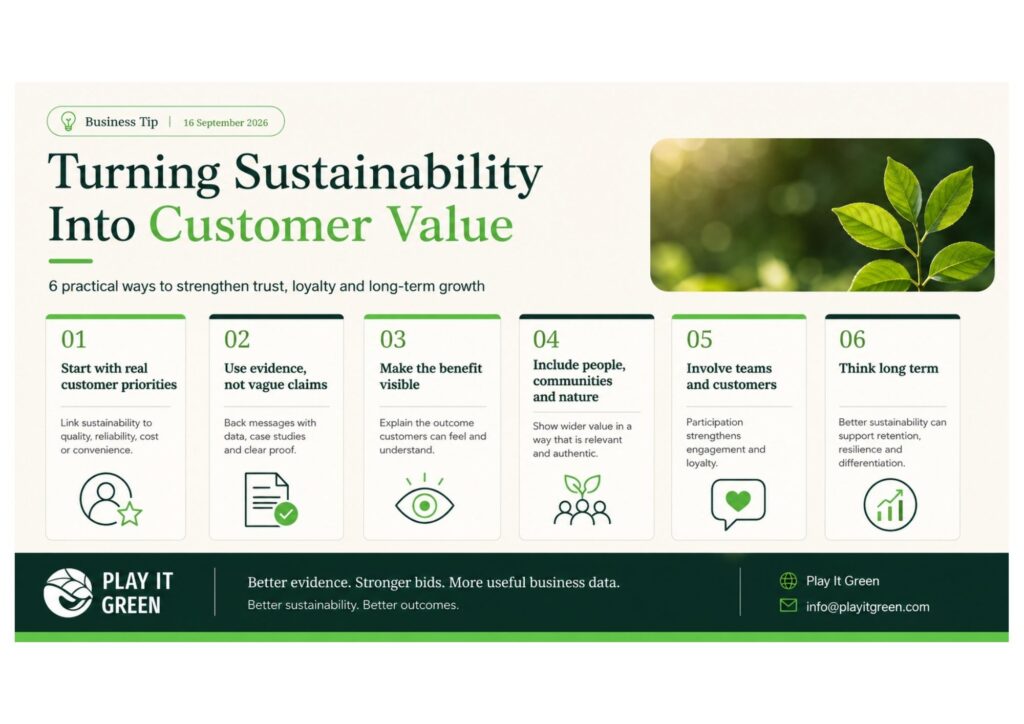
Turning sustainability into customer value starts with a simple commercial question: what becomes better for the customer as a result of the work? Customers still choose products and services for quality, price, convenience, reliability and trust, so environmental and social performance works best when it strengthens those things rather than sitting beside them as a separate message.
Capgemini’s 2025 study of 12,000 consumers across 12 countries found that sustainability was a factor in purchasing decisions for 64% of respondents, yet price and convenience continued to shape what people actually bought. Deloitte’s UK Sustainable Consumer research found that 45% of consumers rely on businesses to offer sustainable products or services as standard, which points to a practical response: make the better choice easy and commercially sensible.

Start With the Customer Problem
A sustainability initiative becomes more valuable when customers can see how it improves the thing they already care about. Lower energy use can reduce running costs, circular design can make products easier to repair, better materials can improve durability, and more efficient logistics can support reliability alongside lower emissions.
The same principle applies to services, where strong carbon data can make reporting easier for a business customer and verified social impact can support its own stakeholder commitments.
Make Sustainability Part of the Offer
Turning sustainability into customer value does not happen when you have sustainability as a separate paragraph on a website, as it limits its commercial value, since customers buy an overall proposition rather than a collection of disconnected credentials.
Bain’s 2025 research into B2B buying found that half of customers already give more business to sustainable suppliers, with nearly 70% expecting to increase those purchases over the following three years. Buyers told Bain that the sustainability of products and services was expected to become their second most significant purchasing criterion by 2028, behind quality and ahead of price and service levels.
For suppliers, that changes the sales conversation, and teams need to explain how an offer helps customers reduce emissions, meet procurement requirements, manage risk, support their own claims or create measurable social and environmental outcomes. The strongest proposition connects sustainability performance to a customer’s existing commercial priorities.
Get In TouchRemove the Friction
Consumers may care about sustainability without wanting extra work, confusing labels or a large price premium. In fact, Capgemini found that 63% of shoppers felt they lacked enough information to verify sustainability claims, and 54% said they did not trust those claims.
Clear information, credible certification, useful comparisons and straightforward choices can reduce the effort customers need to make. Deloitte’s UK research shows the same pressures around affordability, information and ease.
You begin turning sustainability into customer value when your product is good first, with the environmental or social benefit strengthening the reason to choose it.
Use Evidence to Build Trust
Customer value can disappear quickly if a claim feels vague or exaggerated. The Competition and Markets Authority’s Green Claims guidance says environmental claims should be clear, accurate and supported by credible, up-to-date evidence, with relevant information available so customers can make informed decisions.
That does not mean every piece of marketing needs a page of methodology. It means specific claims are usually more useful than broad ones. “Packaging made with 80% recycled material” gives a customer something concrete to understand, and a verified nature project with measurable outcomes gives more confidence than an unsupported promise to “give back to the planet”.
Credibility becomes part of the customer experience when people are already sceptical about environmental marketing.
Remember People, Communities and Nature
Customer value is broader than carbon, and Deloitte’s research found that UK consumers value ethical working practices and respect for human rights alongside sustainable products, waste reduction and lower carbon footprints.
Businesses can create stronger connections when nature repair and social impact are relevant to the product, service or customer relationship. A hospitality business might link guest activity to verified nature repair, and another company might direct part of the value it creates to a cause connected with its customers or community.
The link needs to be clear, credible and proportionate, so customers understand what their choice contributes without the impact claim overpowering the product itself.
Measure What Customers Respond To
The final step is to learn what creates genuine value. Track conversion, repeat purchase, customer feedback, tender performance, retention and the questions sales teams hear most often, then compare those signals with the sustainability features being offered.
Some customers will value lower costs, others will respond to stronger evidence, and others will appreciate the chance to support nature or social outcomes through an everyday purchase. The useful insight is where those needs overlap with impact the business can credibly deliver.

Turning Sustainability Into Customer Value: Wrap-Up
Turning sustainability into customer value occurs when it improves the offer rather than asking customers to compromise for it. Quality, price and convenience still count, but credible environmental and social performance can add trust, differentiation, useful evidence and a stronger reason to stay with a supplier or brand.
The businesses that translate their impact into practical customer benefits can make sustainability easier to understand and easier to buy, with the same work supporting stronger relationships, better sales conversations and more measurable impact over time.
Create Commercial Value with Play It Green
Play It Green helps businesses make sustainability practical, measurable and commercially sensible.
Our members learn through simple weekly education like this article, Turning Sustainability Into Customer Value, reduce their footprint with support and expert signposting, repair nature across land, coast and sea, and create social impact through our 10% revenue giveback to good causes.

That gives your business credible action you can share with employees, customers and other stakeholders, backed by transparent reporting and measurable impact.
If you want to cut costs, reduce risk, attract great people and build stronger customer loyalty through sustainability, including measurement and reduction, nature repair and social impact, speak to Play It Green.
Find Out More