

Sustainability Reporting: Introduction
Sustainability Reporting has moved from a specialist exercise to a core business activity. It now influences planning, investment decisions, customer trust, and long-term resilience. Many teams feel under pressure, yet the issue is rarely a lack of effort. The real challenge is structure. When the foundations behind Sustainability Reporting are unclear, the process becomes stressful and reactive. When the foundations are sound, reporting supports clearer thinking and better decisions across the business.
This Business Tip looks at why Sustainability Reporting feels heavy for so many organisations and what sits underneath reporting that works in practice.

How Sustainability Reporting Reached This Point
Sustainability Reporting started as a way to communicate progress. Over time, it has become something far more revealing. It now shows how well a business is organised, how information flows, and whether leaders can rely on data when making decisions.
Deloitte describes Sustainability Reporting as an internal diagnostic rather than a disclosure exercise. Their work shows that reporting increasingly reflects leadership alignment, operating structure, and governance quality, not just performance metrics.
This shift has happened quickly. Many organisations are expected to produce more detailed reporting without having adjusted the way teams work together. As a result, reporting cycles feel rushed, ownership is unclear, and data lives in too many places. The pressure is felt most sharply near deadlines, which is often a sign that the underlying structure has not settled.
Sustainability Reporting works best when it reflects how a business already operates. When it is bolted on, the cracks show.
Get In TouchWhy Structure Matters More Than Templates
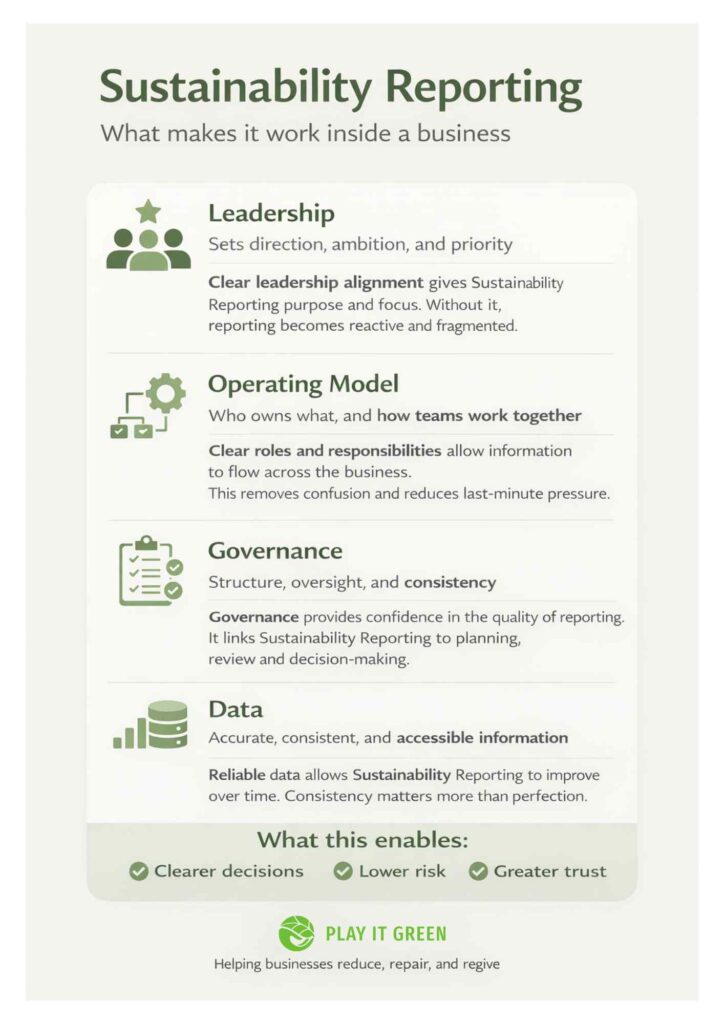
Strong Sustainability Reporting begins with leadership clarity. When leaders share a clear view of why reporting matters, teams gain direction. That purpose may focus on risk management, access to finance, improved planning, or stronger credibility with customers. Once the purpose is agreed upon, reporting stops feeling abstract and starts supporting real decisions.
The next layer is how work moves across the organisation. Many reporting delays come from uncertainty around responsibility. People are often willing to help but unsure what they own or how their contribution fits into the wider picture. Clear ownership reduces friction and helps information flow more naturally.
Governance plays a quiet but important role. A steady rhythm for reviewing information, checking quality, and linking reporting to existing business processes builds confidence. It reassures boards and investors that figures can be trusted and protects teams from last-minute pressure.
Data sits at the centre of everything. Most businesses already collect useful information, yet it is often stored inconsistently or updated irregularly. Sustainability Reporting becomes far easier once data has clear ownership and a consistent home. Perfection is not required. Consistency is what allows reporting to improve over time.
When these elements are in place, reporting stops feeling like an interruption. It becomes part of how the business understands itself.
What to Look For in Sustainability Reporting That Works
Good Sustainability Reporting feels calm rather than frantic. Leaders know what the report is for. Teams understand their role in producing it. Information moves through the business in a predictable way. Reporting timelines align with planning and review cycles rather than sitting apart from them.
You should be able to see how reporting informs decisions. It should support conversations about risk, performance, and opportunity. It should help suppliers engage more clearly and give customers confidence that claims are backed by evidence.
Progress often comes from small changes. Improving one process that slows reporting. Creating one shared place for key data. Bringing sustainability information into existing meetings rather than creating new ones. These adjustments reduce pressure and allow the structure to settle.
As the structure strengthens, reporting becomes easier to repeat and easier to trust.

Sustainability Reporting: Wrap Up
Sustainability Reporting has become a reflection of how well a business is set up for the future. When the structure is unclear, reporting feels heavy and reactive. When the structure works, reporting supports better decisions, stronger trust, and more confident planning.
At Play It Green, we help businesses simplify Sustainability Reporting through clear education, practical reduction support, and credible nature repair. Our focus is on building confidence, not complexity, so reporting becomes something teams can rely on rather than work around.
If Sustainability Reporting feels harder than it should, the answer is rarely more templates. It is almost always better structure.
Reduce. Repair. Regive.

If you enjoyed this article on sustainability reporting, why not join the community and take sustainable action of your own!
We help you reduce your footprint, repair the planet, and regive to social causes that matter, all through simple, measurable actions that fit your business.
Modern employees, consumers, and investors want to see impact, not promises. With Play It Green, your sustainability journey becomes visible, credible, and commercially rewarding.
Join us today and turn good intentions into lasting results.