

Sustainability Terms – F Edition: Introduction
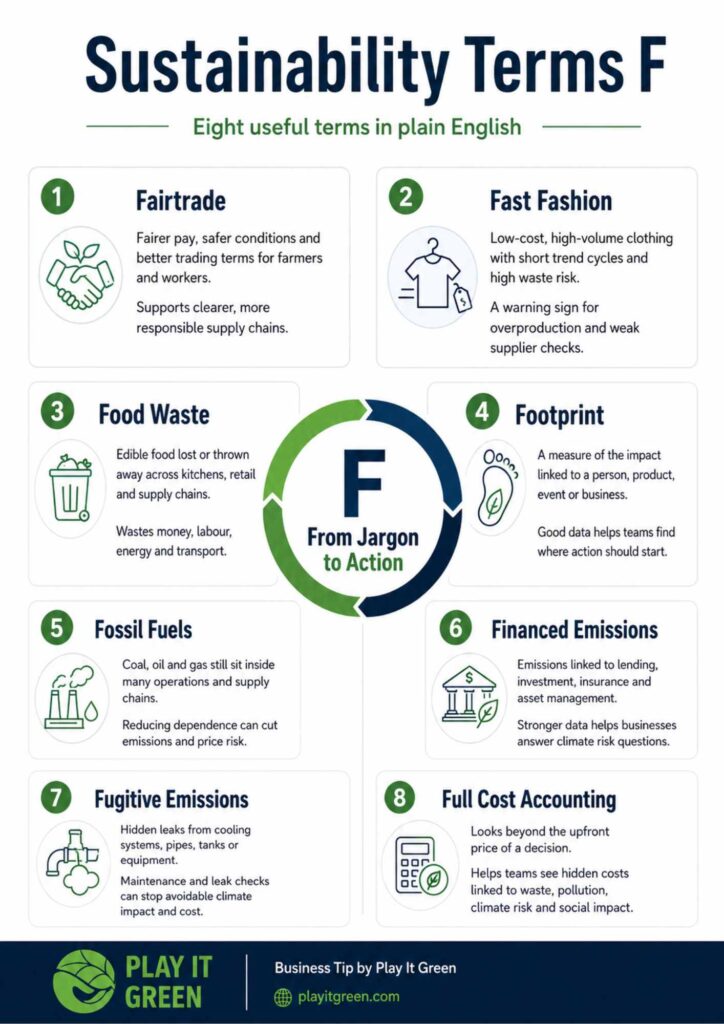
This week, we continue our monthly A-Z guide with Sustainability Terms – F Edition. The guide is for companies that want plain English, not jargon, and this month’s terms appear everywhere from supply chain questions and food systems to energy plans and sustainability statements. Some affect cost, some affect risk, and some affect how customers, staff and investors judge a business.
For this article, we have chosen eight terms that business leaders are likely to hear more often. The aim is simple: explain what each one means, why it matters commercially, and how it links to better decisions.

Fairtrade
Our first term in Sustainability Terms F Edition is Fairtrade, which is a certification and trading approach created to give farmers and workers fairer pay, safer conditions and better terms of trade. It is most common in products such as coffee, cocoa, tea, bananas, sugar, flowers and cotton.
Procurement teams, hospitality venues, retailers and office managers may all come across Fairtrade when buying products for staff, customers or resale. A Fairtrade product gives buyers a clearer route to support fairer supply chains, rather than relying on vague claims about ethics or responsibility. It can help show that people behind a product have been paid and treated more fairly.
The useful point is that Fairtrade links sustainability to people, livelihoods and trade, not just carbon. It reminds companies that responsible business is about how value moves through supply chains, and who benefits from the products being sold.
Fast Fashion
Our next term in Sustainability Terms – F Edition, is Fast fashion, which means clothing produced quickly, cheaply and in high volumes, often linked to short trend cycles and low levels of reuse. The model depends on speed, constant newness and high sales volumes, with many garments worn only a few times before being thrown away.
The commercial risk is in overproduction, poor material choices, weak supplier checks, low wages, high waste and reputational damage. The same pattern can appear outside fashion too, wherever products are made fast, sold cheaply and replaced often.
Better practice includes higher-quality design, repair, resale, rental, pre-order models, recycled materials, supplier checks and clearer customer education. The commercial shift is away from volume at any cost and closer to products, services and relationships that create value for longer.
Food Waste
Food waste means edible food that is lost, thrown away or left unused across farms, factories, hospitality, retail, offices and homes. It can happen through overbuying, poor storage, large portions, forecasting errors, damaged stock, short shelf life or limited routes for redistribution.
In hospitality, retail and food production, waste often has an impact on margins. It means wasted ingredients, wasted labour, wasted energy, wasted transport and wasted money. Teams can be working hard, serving customers well and still losing cash through food that should never have been binned.
Good food waste action starts with data: Businesses can track waste by weight, value and reason, then adjust purchasing, menus, storage, stock rotation, portion sizes and donation routes. Cutting food waste is often one of the most practical ways to save money and reduce emissions at the same time.
Footprint
A footprint is a measure of the impact linked to a person, product, business, event or activity. Most people use the term to mean carbon footprint, which measures greenhouse gas emissions, but a wider footprint can include water, land, waste, materials and pollution.
This is important when leaders need to know where the biggest impacts from their business sit. Those impacts may come from energy, travel, packaging, purchased goods, staff commuting, waste or product use. Without a footprint, many companies rely on assumptions, and assumptions can send time and money to the wrong places.
As part of Sustainability Terms – F Edition, a footprint is only useful if it leads to action. The value comes from using the data to cut waste, reduce emissions, improve procurement, engage teams and give customers or buyers clearer evidence of progress.
Get In TouchFinanced Emissions
Financed emissions are greenhouse gas emissions linked to financial activity, such as lending, investment, insurance or asset management. The term is most relevant for banks, pension funds, investors, insurers and financial institutions that provide capital to high-emitting sectors or companies.
The link with finance makes this term more relevant for growing companies than many people realise. Lenders and investors are asking tougher questions about emissions, transition plans, energy use, supply chains and exposure to carbon-heavy activity. Companies seeking funding may face more requests for data, targets and evidence.
As part of Sustainability Terms – F Edition, this shows why sustainability has moved into finance teams and boardrooms. Stronger emissions data and credible plans can support access to capital, reduce risk and help companies answer investor questions with more confidence.

Fugitive Emissions
Fugitive emissions are leaks or unintended releases of gases from equipment, pipes, valves, tanks, refrigeration, air conditioning or industrial systems. They can be hard to spot, yet some leaked gases can carry a high climate impact.
The risk is greatest where a business relies on cooling, heating, chemicals, gases, fuel storage or industrial processes. Supermarkets, hospitality venues, offices, manufacturers, logistics firms and food businesses may all have equipment where leaks can occur.
The practical response is regular maintenance, leak checks, good records, staff training and better equipment choices. Reducing fugitive emissions can cut climate impact and costs, improve safety, reduce waste and protect the business from avoidable repair costs.
Full Cost Accounting
The penultimate term in Sustainability Terms – F Edition, is full cost accounting which is an approach that looks beyond the direct price of a product, service or decision. It tries to include wider costs linked to environmental harm, waste, pollution, health, resource use, climate risk and social impact.
This is useful in procurement, product design, investment decisions, packaging reviews and sustainability strategy. The cheapest option can carry costs that appear later. A low-cost material may create disposal problems, whilst a poor supplier choice may create reputational risk and a cheap energy source may increase exposure to future regulation or price changes.
This approach helps teams compare choices more honestly. The point is not to make every decision slow or complicated, but rather, it is to stop hidden costs being ignored until they become expensive problems.

Fossil Fuels
Fossil fuels are coal, oil and gas, and they are formed over millions of years from ancient plant and animal matter and release greenhouse gases when burned. They still create much of the energy, heat, transport, manufacturing and materials used by modern business.
A company’s dependence can be direct or hidden. Direct use may include gas boilers, diesel vans, petrol cars and on-site generators. Hidden use comes from electricity, plastics, packaging, outsourced transport, supplier energy and product materials.
Reducing fossil fuel use can lower emissions, reduce exposure to price shocks and support cleaner business growth. Practical steps include energy efficiency, renewable electricity, electric vehicles, lower-carbon heat, better logistics, cleaner materials and supplier questions that go beyond the lowest price.
And that, is the last sustainability phrase in this month’s Sustainability Terms – F Edition.
Sustainability Terms – F Edition: Wrap-Up
Your Sustainability Terms – F Edition shows how sustainability language connects to real business choices. These eight terms connect trade, clothing, food, carbon, finance, energy, operations and decision-making.
The best move is to spot which terms affect your organisation now, then turn that knowledge into practical action. Learn the language, gather the data, cut waste, ask better supplier questions and make claims that can stand up to scrutiny. That is far better than nodding through a meeting and hoping nobody asks what fugitive emissions are.
If you enjoyed the Sustainability Terms – F Edition, why not become part of a community creating positive change by partnering with Play It Green and receive these tips weekly straight to your inbox? All whilst planting trees, mangroves and sea kelp and supporting a charity of your choice!
We help you reduce your footprint, repair the planet, and regive to social causes that matter, all through simple, measurable actions that aren’t hard to do.

Modern employees, consumers, and investors want to see impact, not promises. With Play It Green, your sustainability journey becomes visible, credible, and rewarding.
Join us today and turn good intentions into lasting results.
Sign Up