

Sustainability Terms for Business – C Edition: Introduction
Sustainability Terms for Business – C Edition continues our A–Z guide with a focus on carbon, climate, and governance language that shapes real business decisions.
Many of these C sustainability terms for business appear regularly in strategy documents, reporting frameworks, and investor conversations. They are often used confidently, yet not always clearly understood across teams. When terminology lacks precision, sustainability becomes discussion rather than discipline.
Carbon and climate language in particular has grown dense. Acronyms multiply, targets are announced, and frameworks overlap. Without a shared understanding of the core concepts, it becomes difficult to connect emissions data to procurement choices, risk management, or board oversight. This edition concentrates on the terms that sit closest to measurement, exposure, and accountability.

Carbon Accounting
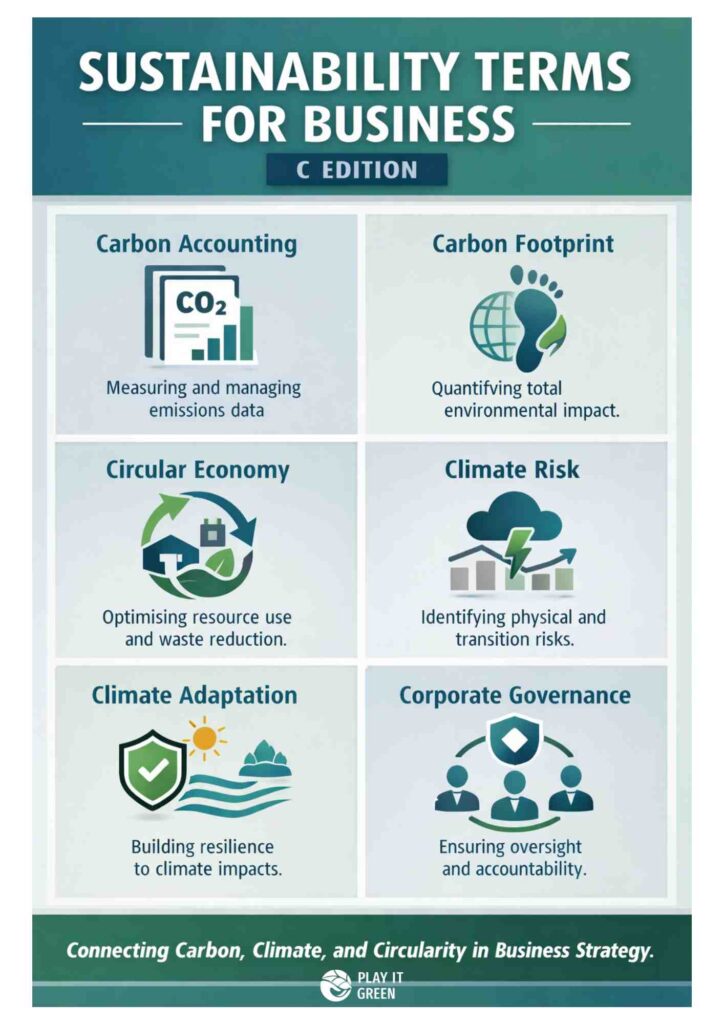
Carbon accounting is the structured process of measuring and reporting greenhouse gas emissions linked to an organisation’s activities. It follows recognised methodologies to calculate emissions across operations, energy use, transport, and supply chains.
For businesses, carbon accounting provides a consistent basis for targets and disclosures. It allows emissions to be compared year on year and across business units. Without it, reduction claims lack credibility and reporting becomes inconsistent. Among the C sustainability terms for business, carbon accounting establishes the foundation for everything that follows.
Carbon Footprint
A carbon footprint represents the total greenhouse gas emissions associated with an organisation, product, service, or activity. It converts detailed emissions data into a single measurable figure.
That figure informs reduction strategies, procurement decisions, and capital planning. It is also the number most frequently referenced in public reporting and net zero commitments. Carbon footprint calculations give leaders a clearer view of exposure and progress, turning technical data into something operationally meaningful.
Get In TouchCircular Economy
The circular economy is an economic model designed to keep materials and products in use for as long as possible, reducing waste and regenerating resources.
For businesses, this affects product design, sourcing decisions, packaging, logistics, and lifecycle planning. Instead of focusing on disposal, circular thinking questions how materials can be reused, repaired, or recovered. It links sustainability directly to efficiency and cost management rather than treating it as a separate initiative.
Climate Risk
Climate risk refers to the financial and operational risks arising from climate change. These risks are typically categorised as physical or transition risks.
Physical risks include extreme weather events, flooding, and heat stress that disrupt operations or supply chains. Transition risks arise from regulatory change, shifting consumer expectations, and evolving market standards. Climate risk now influences insurance costs, asset valuation, financing conditions, and long-term investment decisions.
Climate Adaptation
Climate adaptation is the process of adjusting business operations, infrastructure, and strategy in response to actual or expected climate impacts.
Where mitigation seeks to reduce emissions, adaptation focuses on resilience. Organisations may diversify suppliers, strengthen facilities, or revise contingency planning. Adaptation recognises that some climate impacts are already present and must be managed rather than deferred.
Corporate Governance
Corporate governance refers to the oversight systems and leadership structures that direct and control an organisation.
When sustainability is embedded within governance, emissions data, climate risk, and resilience planning are reviewed at board level. Accountability is formalised, and responsibilities are defined. Without governance, sustainability efforts remain fragmented and dependent on individual champions rather than institutional commitment.

How These C Terms Connect
Sustainability Terms for Business – C Edition form a progression rather than a list.
Carbon accounting provides the method for measurement. Carbon footprint expresses that measurement in a usable and communicable form. Circular economy thinking influences how resources are managed once impacts are visible, linking emissions to design and procurement decisions rather than reporting alone.
Climate risk broadens the frame by considering how environmental change may affect assets, supply chains, and cost structures. Climate adaptation responds to that exposure through practical adjustment. Corporate governance ensures that each of these elements is reviewed, challenged, and embedded in oversight structures.
Taken together, these C sustainability terms for business describe how organisations move from measuring impact to managing resilience. The language connects data, operations, and leadership responsibility in a structured way.
Sustainability Terms for Business – C Edition: Wrap Up
Sustainability becomes effective when language becomes operational.
The Sustainability Terms for Business – C Edition influence procurement choices, cost exposure, resilience planning, and leadership accountability. When teams share a clear understanding of the terminology, strategy becomes more coherent and implementation more disciplined.
Clarity does not guarantee success, but confusion almost guarantees drift. Shared language creates the conditions for consistent decision-making.
If you want support turning sustainability into something your teams can actually use, get in touch.
If you enjoyed this article on the Sustainability Terms for Business – C Edition, why not become part of a community creating positive change by partnering with Play It Green?
We help you reduce your footprint, repair the planet, and regive to social causes that matter, all through simple, measurable actions that fit your business.

Modern employees, consumers, and investors want to see impact, not promises. With Play It Green, your sustainability journey becomes visible, credible, and rewarding.
Join us today and turn good intentions into lasting results.
Sign Up