

Sustainability Terms for Business – D Edition: Introduction
Sustainability Terms for Business – D Edition continues our A–Z guide by focusing on terminology that increasingly shapes regulation, reporting, and operational change. Many of these D sustainability terms for business now appear in board discussions, investor briefings, and supplier requirements, yet they are not always clearly understood across organisations.
As sustainability moves from aspiration to accountability, language becomes more precise and expectations more structured. Terms linked to emissions reduction, supply chain responsibility, and corporate disclosure now influence compliance, reputation, and long-term resilience. This edition explains several of the concepts that businesses are encountering more frequently and shows how they connect in practice.

Decarbonisation
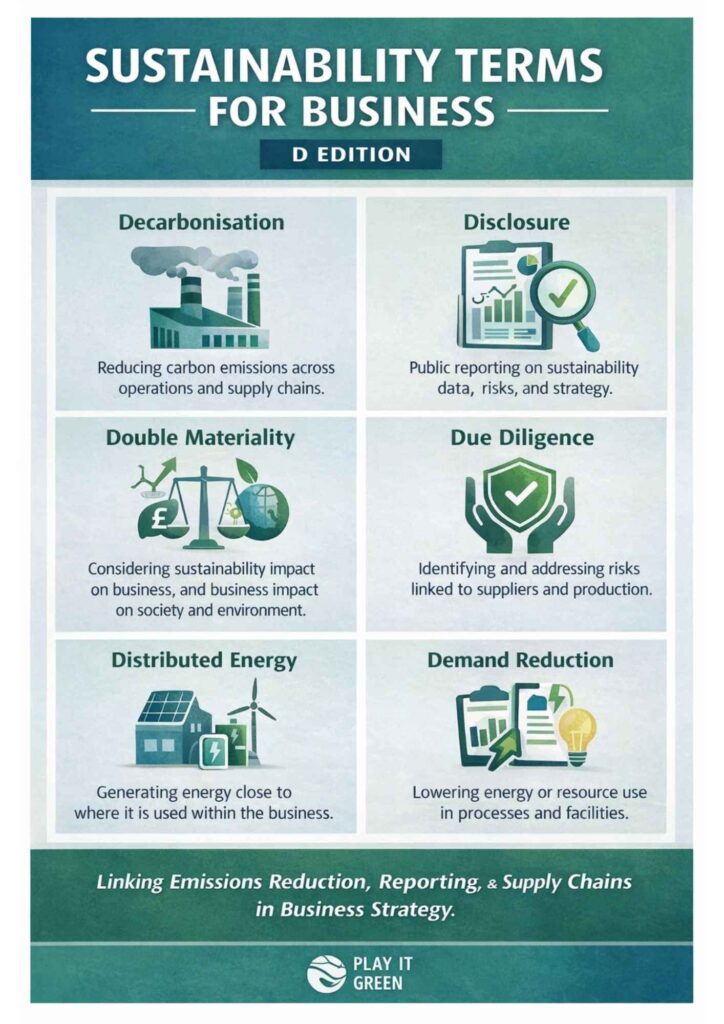
The first term in our Sustainability Terms for Business – D Edition is decarbonisation. Decarbonisation refers to the process of reducing carbon emissions across an organisation’s activities. It usually focuses on energy use, transport, manufacturing processes, and supply chains.
For businesses, decarbonisation often begins with measuring emissions and identifying where the largest sources occur. From there, organisations may improve efficiency, switch to renewable energy, redesign products, or work with suppliers to reduce emissions further along the value chain. The aim is to progressively lower the carbon intensity of operations while maintaining commercial performance.
Disclosure
Disclosure refers to the public reporting of environmental, social, and governance information. Increasingly, regulators, investors, and customers expect companies to disclose data related to emissions, climate risk, and sustainability strategy.
Effective disclosure provides transparency and allows stakeholders to assess how organisations are managing environmental impacts and long-term risk. It also supports comparability across companies and sectors. In recent years, disclosure requirements have expanded significantly, reflecting the growing expectation that sustainability performance should be visible and accountable.
Get In TouchDouble Materiality
Double materiality is a concept used in sustainability reporting to assess which issues matter most. It considers two perspectives simultaneously: how environmental and social issues affect the organisation financially, and how the organisation’s activities affect society and the environment.
By evaluating both directions of impact, businesses can prioritise the issues that require the greatest attention. Double materiality is now embedded in several reporting frameworks and regulatory approaches, making it an increasingly important concept for organisations preparing sustainability disclosures.
Due Diligence
Sustainability due diligence refers to the processes organisations use to identify, prevent, and address environmental and human rights risks within their operations and supply chains.
This may involve assessing suppliers, monitoring labour practices, reviewing sourcing standards, or investigating environmental impacts linked to production. Due diligence helps organisations manage risk and demonstrate responsible business conduct, particularly as regulatory expectations around supply chain transparency continue to increase.
Distributed Energy
Distributed energy refers to electricity generation that occurs close to where it is used rather than at large centralised power stations. Examples include rooftop solar systems, on-site wind generation, and small-scale energy storage.
For businesses, distributed energy can increase resilience, reduce reliance on external grids, and lower emissions associated with electricity consumption. It is becoming more common as organisations seek greater control over energy costs and energy security.
Demand Reduction
The final term in our Sustainability Terms for Business – D Edition series is demand. Demand reduction focuses on lowering the overall energy or resource consumption required to operate a business. Instead of simply switching to cleaner energy sources, organisations look at how processes, buildings, or equipment can be redesigned to require less energy in the first place.
Examples include improving building insulation, optimising production processes, reducing unnecessary transport, or using more efficient equipment. Demand reduction often provides some of the fastest and most cost-effective sustainability gains because it directly reduces operational expenses.

How These D Terms Connect
The concepts in Sustainability Terms for Business – D Edition work together rather than standing alone.
Decarbonisation defines the overall direction of travel as organisations seek to reduce emissions. Demand reduction and distributed energy provide practical pathways for achieving those reductions within operations and infrastructure. Disclosure and double materiality determine how organisations communicate their priorities and impacts, while due diligence extends responsibility across supply chains.
When viewed together, these D sustainability terms for business illustrate how emissions reduction, transparency, and operational change increasingly form part of normal business management rather than separate sustainability initiatives.
Sustainability Terms for Business – D Edition: Wrap Up
Sustainability terminology continues to evolve as expectations around accountability and transparency grow. The concepts explored in this D edition highlight how emissions reduction, disclosure, and supply chain responsibility are becoming embedded within everyday business practice.
Understanding these terms helps organisations interpret emerging regulations, respond to investor expectations, and design strategies that balance environmental progress with commercial resilience.
If you enjoyed this article, Sustainability Terms for Business – D Edition, why not become part of a community creating positive change by partnering with Play It Green and receive these tips weekly straight to your inbox?
We help you reduce your footprint, repair the planet, and regive to social causes that matter, all through simple, measurable actions that fit your business.

Modern employees, consumers, and investors want to see impact, not promises. With Play It Green, your sustainability journey becomes visible, credible, and rewarding.
Join us today and turn good intentions into lasting results.
Sign Up