

Sustainable Business Banking: Introduction
Sustainable Business Banking deserves far more attention than it gets, as a bank’s biggest climate impact usually sits in what it finances, not in its branches or head office. Deloitte says financed emissions account for around 75% of a bank’s carbon footprint, and a 2025 Bank Underground analysis said the figure is over 95% for many banks. The Partnership for Carbon Accounting Financials, whose standard is widely used across financial institutions, says financed emissions are the largest share of their climate impact and the basis for better disclosure and decision-making.
That gives this topic real commercial weight. A business may spend months cleaning up travel, packaging, and procurement, then leave its banking untouched for years. In practice, that can leave company money sitting inside a system still backing high-carbon activity. The result is awkward. Your climate story improves on one side of the business, though your banking relationship may still point the other way.

Why Sustainable Business Banking matters
The key point is simple. Bank emissions are mostly created by lending and investment decisions, so two banks with similar day-to-day operations can carry very different climate footprints. That is why switching matters as it changes the financial relationship behind your business, not just the logo on your statements.
There is a useful real-world example here. Holdfast Projects found that switching from Santander to Starling was expected to cut its footprint by nearly 400 kgCO2e a year, and it described banking and financial services as roughly half of that organisation’s footprint. One company case study does not settle the question for everyone, though it does show how large this hidden category can become.
The reason this works so well for smaller businesses is that banking is one of the easier levers to pull. The Current Account Switch Service says the process is handled by the new bank, takes seven working days, and includes payment redirection and a guarantee if something goes wrong. Compared with changing premises, fleets, or major suppliers, Sustainable Business Banking can be a relatively light operational move with a meaningful impact story behind it.
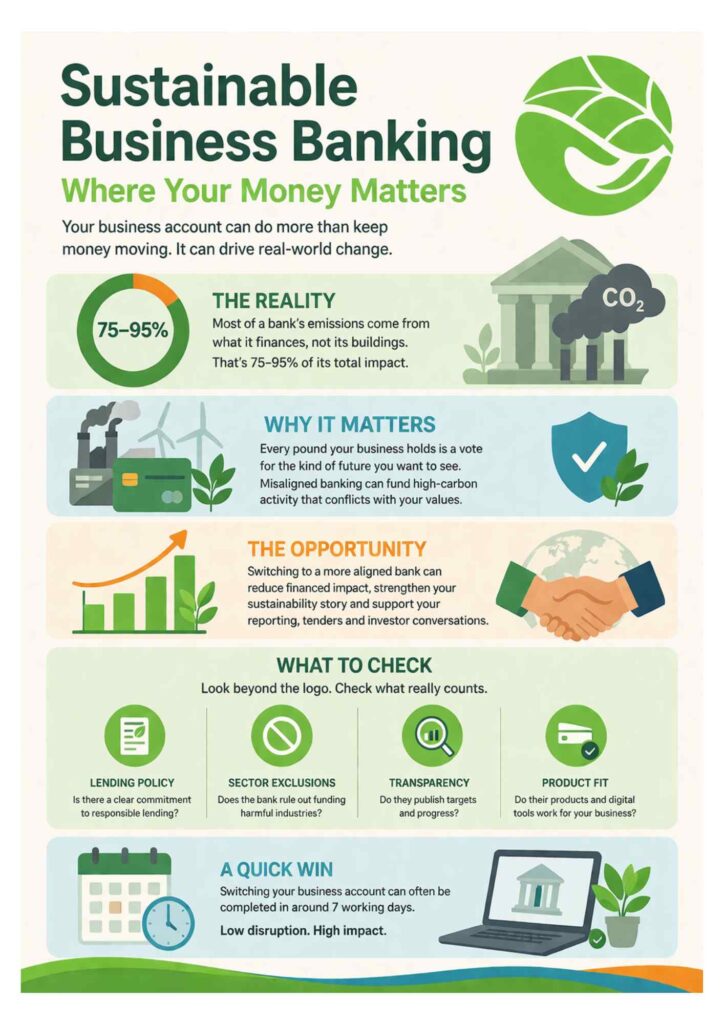
What Sustainable Business Banking should make you check
Start with policy as if a bank cannot explain clearly what it funds, what it excludes, and how it screens sectors, take that seriously. This is where a lot of green claims start to wobble. Stronger options tend to be much clearer about fossil fuels, harmful sectors, and customer screening.
Then check whether the product actually works for your business. Good ethics will not rescue poor banking, as you still need decent online access, payment tools, support, integrations, and something that does not make payroll or cash flow harder than it needs to be. The point of Sustainable Business Banking is to improve alignment without creating friction that the finance team ends up hating.
Get In TouchBanks worth a closer look
For UK businesses, The Co-operative Bank is one of the clearest mainstream options. It says it is the only UK high street bank with a customer-led Ethical Policy, and its planet commitments state that it has not provided banking services to businesses involved in fossil fuel extraction since 1998. That gives businesses something rare in this space: a recognisable brand with a published line in the sand.
Starling is a strong digital option for small and medium-sized enterprises that want a smoother operational experience. Its sustainable banking material says it is branchless and largely paperless, and that its debit cards were the first UK Mastercard debit cards made from recycled plastic. Its carbon reduction plan says its digital-first model and recycled cards are part of its approach to lowering operational impact. That does not make Starling the purest ethical bank in the market, though it does make it a practical option for firms that want modern banking with a lighter footprint.
Triodos remains the strongest mission-led name to mention. In June 2025, Triodos Bank UK said it had delivered £2.5 billion in lending to projects with social and environmental impact since its launch. There is one catch, and it matters. Its 2025 annual report said a new business current account proposition is still hard to deliver anytime soon, so businesses should treat Triodos today as a strong benchmark for impact-led banking rather than assume every business banking product is currently open. That is a good example of why Sustainable Business Banking should always be judged on live availability, not brand reputation alone.

Sustainable Business Banking: Wrap-Up
Sustainable Business Banking matters as it changes what your company’s money may be helping to support every day. That is why it is more than a back-office tidy-up, as it can reduce financed-impact exposure and strengthen credibility in environmental, social, and governance conversations.
It also gives your business a cleaner answer when clients, investors, or suppliers ask tougher questions. For something that can often be switched in seven working days, that is a surprisingly weighty piece of the puzzle.
If you enjoyed this article on Sustainable Business Banking, why not become part of a community creating positive change by partnering with Play It Green and receive these tips weekly straight to your inbox?
We help you reduce your footprint, repair the planet, and regive to social causes that matter, all through simple, measurable actions that fit your business.

Modern employees, consumers, and investors want to see impact, not promises. With Play It Green, your sustainability journey becomes visible, credible, and rewarding.
Join us today and turn good intentions into lasting results.
Sign Up