

Doughnut Economics: Introduction
Doughnut economics puts a simple shape to a big idea: how do we meet everyone’s needs without breaking the planet? Economist Kate Raworth’s model gives businesses a visual tool to rethink strategy through a social and ecological lens. It’s not about being perfect. It’s about knowing where you stand and making better choices.
As expectations shift, companies are under growing pressure to show how they’re adding value without causing harm. That’s where the doughnut helps. It replaces guesswork with a framework that links business goals to long-term resilience, well-being and sustainability. And it makes complex decisions simple.

The Doughnut Model: A Quick Overview
At the heart of doughnut economics is a simple image. There is an inner ring that marks the minimum standard for human wellbeing. If people lack food, healthcare, education or justice, they fall into the hole. Then there is the outer ring, which represents environmental limits. Push past it and you risk climate breakdown, pollution, biodiversity loss and the collapse of systems we all rely on.
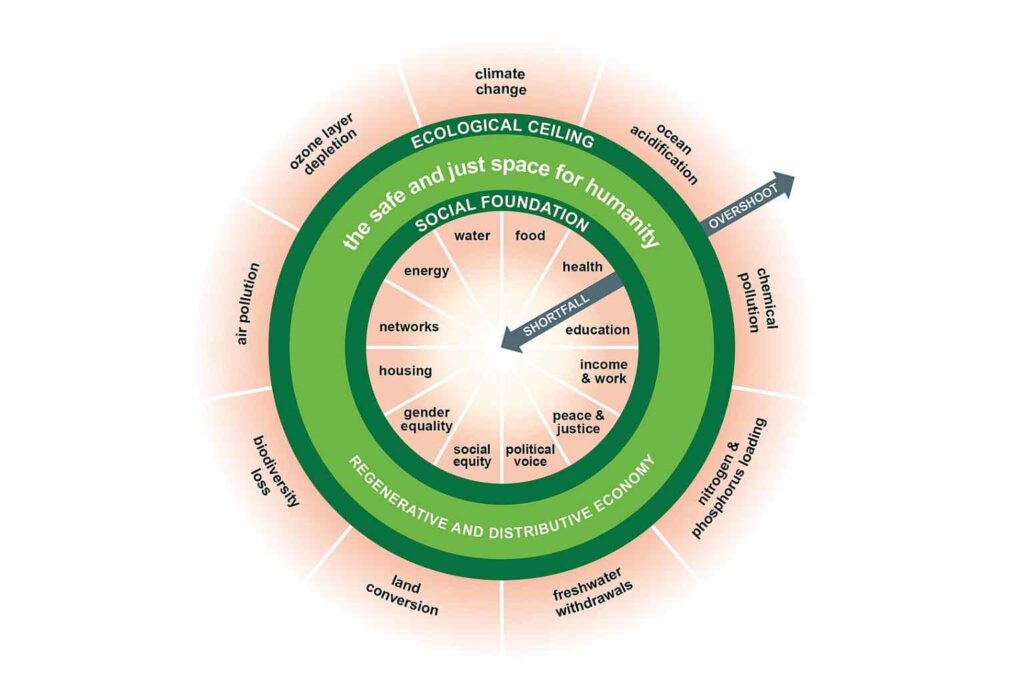
Between these rings lies the safe and just space for humanity. It is where we can grow, innovate and live well without pushing anyone into poverty or nature into crisis.
This concept maps neatly to the United Nations Sustainable Development Goals. The inner ring ties to social goals like SDG 1 (No Poverty), 3 (Good Health), 4 (Quality Education) and 5 (Gender Equality). The outer ring reflects environmental goals like SDG 13 (Climate Action), 14 (Life Below Water) and 15 (Life on Land).
Doughnut economics shows us that growth at any cost is short-sighted. Real progress sits between these rings. That is where business, people and planet can all thrive.
The Business Case for the Doughnut
So, why should business leaders care about doughnut economics?
Because it is about risk, value and long-term success. Operating outside the doughnut comes with real consequences. Environmental overshoot brings regulation, resource scarcity and reputational damage. Social shortfalls create unstable markets, inequality and unrest. None of that is good for business.
Staying within the doughnut, on the other hand, builds resilience. It helps companies attract talent, earn trust, access new markets and meet ESG expectations with substance. Investors are watching. Consumers are questioning. Employees are choosing workplaces that align with their values.
This model also helps shift the narrative. It is not about sacrifice. It is about designing products, services and supply chains that support wellbeing and regeneration. It reframes sustainability as a value driver, not a side project.
And while some might see it as a theory, plenty of companies are already using it to guide decision-making. From product design to procurement, board strategy to annual reporting, the doughnut gives a bigger picture. One that helps leaders plan for the future without wrecking it.

How to Use It: From Model to Action
Doughnut economics is not a step-by-step guide, but it is a brilliant lens. It helps you ask better questions and spot gaps in your impact.
Start by mapping your current activity. Are you helping people thrive or leaving gaps in pay, wellbeing or rights? Are you causing harm to water, air, biodiversity or the climate? Where do you fall short or overreach?
Next, link those insights to the SDGs. Responsible production (SDG 12), clean energy (SDG 7) and decent work (SDG 8) are a great place to start. Use the doughnut to stress test decisions. Would this move push us beyond social or environmental limits?
Then, redesign. Can you reduce emissions, cut waste or shift to regenerative materials? Can you build partnerships that support local economies or improve supply chain ethics? Progress counts.
Some businesses are now applying doughnut thinking at city, sector or strategy level. Others are using it to reshape how they measure success.
Best of all, you don’t have to be perfect, just committed. Doughnut economics is about direction, not dogma.

Doughnut economics: Wrap-Up
Doughnut economics offers businesses a clear, visual and practical framework for creating value without causing harm. And let’s be honest. The future belongs to those who get this right. With the SDGs as your guide and the doughnut as your map, you can grow your impact and protect your future at the same time.
At Play It Green, we help businesses reduce footprints, repair nature and regive to society. If you want support making the doughnut part of your strategy, we are ready when you are.
Regenerative, fair and forward-thinking. That is where the smart money is going.
Embrace Doughnut Economics with Play It Green
By partnering with Play It Green, you can integrate sustainable action, education, tree planting, mangrove restoration, seaforestation and social impact into your business operations. Whether it’s adding nature repair to your sales process, engaging employees, or strengthening your environmental credentials, the tools and support are there to make it simple.
Every action contributes to restoring the planet.
Want more info before deciding? Click here.