 Skip to content

Guest Business Tip by Rachel Sheila Kan, Co-Founder of Real Circularity
Business Buy-In for Circularity: Introduction
Getting Business Buy-In for Circularity is what decides whether circular ideas stay as good intentions or become part of a working business model. Lots of brands like the sound of circularity; however, far fewer build it into product design, sourcing, pricing, retail, reuse, and remake. That is where progress starts or stalls.
Rachel Sheila Kan has spent years working on applied circularity, mainly in fashion. Her view is straightforward: To get Business Buy-In for Circularity, it has to make sense at the product level, business level, and customer level. A concept can sound exciting in a meeting, yet it will not last unless it works in the real world.

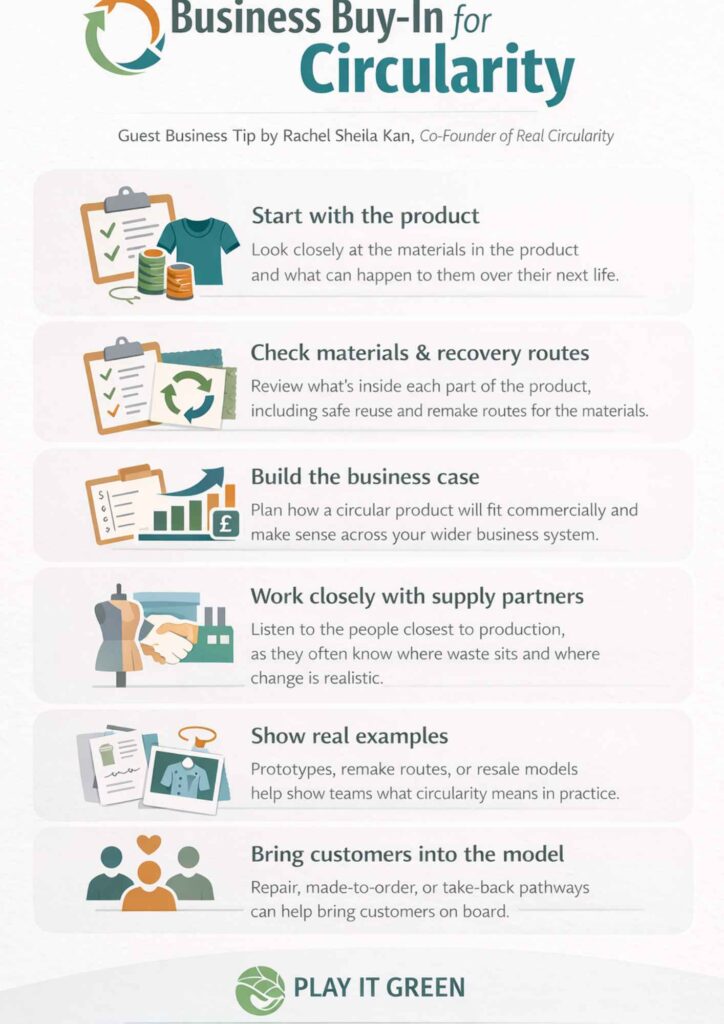
Start with the product
One of the clearest lessons from circular work is that you need to begin with the product itself. Rachel’s co-founder, Ken, worked on the world’s first circular office chair with Herman Miller. That project went far beyond appearance. It meant looking closely at materials, chemistry, safety, and what would happen when the chair was taken apart and made again.
Rachel describes this as the “zoom in”. You look at what is in a product, what sits inside each component, and what happens next once it is repaired, recovered, or remade. A product may look circular at first glance, yet the real test is whether its materials can move safely into another life without creating fresh problems.
That detail matters as if circularity is weak at the material level, the wider model usually falls apart.
Build the business case around it
Once the product is right, the business around it has to work too. A circular product still needs market fit, clear pricing, team support, and a workable route through the wider system. That includes sourcing, merchandising, sales, returns, repair, resale, take-back, and redevelopment.
This is where buy-in often fades. Circularity can end up parked with one team instead of becoming part of the core model. Rachel’s view is that real buy-in grows once people can see how the work connects to revenue, operations, customer value, and brand strength.
Put simply, to get business buy-in for circularity, it needs to be treated as a commercial design question, not a side project or a tick box exercise.
Why bottom-up work can move faster
Rachel has been developing what she calls a “bubble up” approach. Instead of relying only on direction from head office, progress can start closer to the manufacturing base, the mills, and the product itself.
That matters in fashion as supply partners often know where waste sits, where materials can change, and where a better route is realistic. Head office can set direction, yet real movement often comes from the people closest to production.
This place-based way of working can be more agile and more grounded. Real Circularity has been developing work in this way, including partnership activity with Maveneco in the denim space.
Show people what is possible
One of Rachel’s strongest points is that businesses buy in faster once they can physically see what is possible. A prototype, a remake route, a resale model, or a product with more than one revenue stream gives teams something real to assess.
That is far stronger than abstract circular language.
Real Circularity has used this thinking across a range of projects. Its regenerative circular work with Sanja Stories tests a model where the customer becomes part of the process. Its work with Vandal Kids looked at longevity in children’s wear and built a strategy around multiple revenue routes.
Small projects can have real value to get business buy-in for circularity. They give businesses proof, reveal friction, and help shape better decisions.

Business Buy-In for Circularity: Wrap-Up
Business Buy-In for Circularity grows once circularity is treated as part of product design, commercial planning, and customer experience from the start. Rachel Sheila Kan’s work shows that progress comes from real products, real trials, and close work with the people nearest to production.
For businesses that want circularity to move from theory into practice, the route is clear. Start with the product, build the business case around it, and prove the model in real life.
About the Author of Business Buy-In for Circularity, Rachel Sheila Kan
Rachel Sheila Kan is Co-Founder of Real Circularity. She works with brands and supply partners to turn circular thinking into practical commercial action, with a strong focus on fashion, product design, materials, and supply systems.
If you enjoyed this article on Business Buy-In for Circularity, why not become part of a community creating positive change by partnering with Play It Green and receive these tips weekly straight to your inbox?
We help you reduce your footprint, repair the planet, and regive to social causes that matter, all through simple, measurable actions that fit your business.

Modern employees, consumers, and investors want to see impact, not promises. With Play It Green, your sustainability journey becomes visible, credible, and rewarding.
Join us today and turn good intentions into lasting results.


