Skip to content

Climate Risk for Business: Introduction
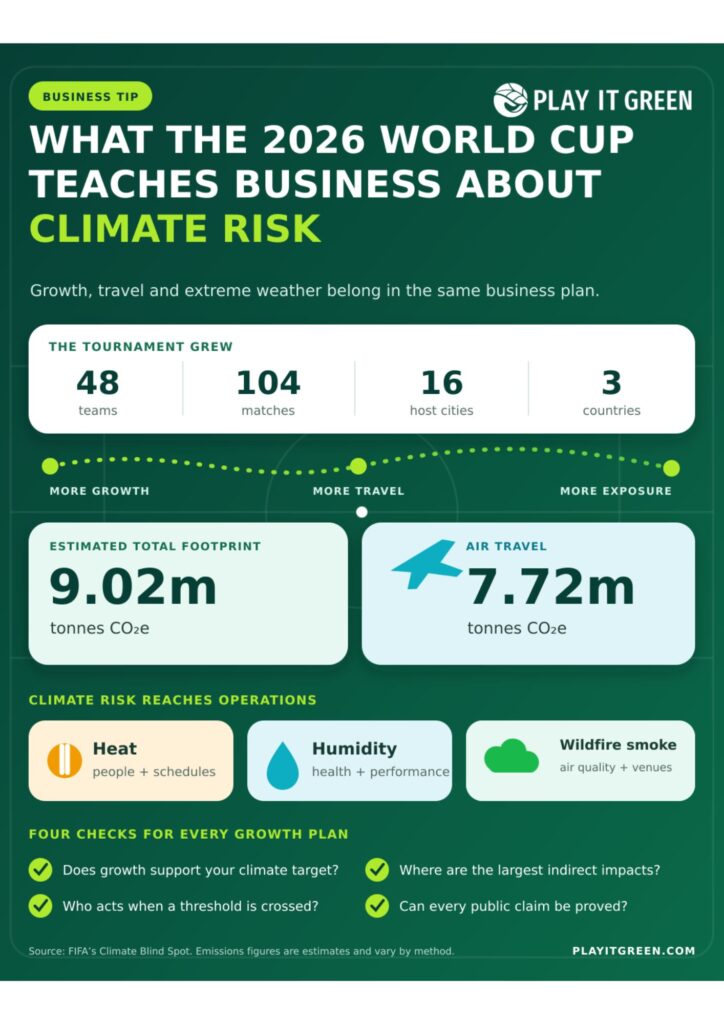
Climate risk for business can sound distant until heat, smoke or disrupted travel starts affecting staff, customers and operations. The 2026 FIFA World Cup has made that connection visible on a huge scale. The expanded tournament brought 48 teams and 104 matches across 16 host cities in Canada, Mexico and the United States.
A 2025 report, FIFA’s Climate Blind Spot, warned that the format would increase emissions and expose players, supporters and host cities to serious climate hazards. Events during the competition gave businesses a case study in what happens when growth plans, environmental targets and operational risk are considered separately.

Growth Changes the Footprint
The 2026 tournament grew from 32 to 48 teams, with the number of matches rising from 64 to 104. FIFA presented the format as a way to include more nations and supporters, yet a larger event spread across three countries created far more travel.
The 2025 report estimates a tournament footprint of 9.02 million tonnes of carbon dioxide equivalent, compared with a 4.71 million-tonne average across the 2010 to 2022 World Cups. Air transport accounts for an estimated 7.72 million tonnes of the 2026 total. Another analysis published in 2026 reached a lower estimate of 7.8 million tonnes, with spectator travel responsible for close to 88%.
The exact total will depend on final attendance, travel patterns and calculation choices. Both studies reach the same broad finding: the decision to expand the tournament and spread it across a continent shaped the footprint before the first match began.
Climate Risk Moved onto the Pitch
The same format created operational risks. Research published before the tournament found that afternoon kick-offs carried the greatest exposure to extreme heat. By 16 July, Guardian analysis found that nearly one in five matches had reached heat and humidity levels at which the players’ union FIFPRO recommends delaying or postponing play.
FIFA uses a higher intervention threshold. Reuters reported on 10 July that none of the first 94 matches had crossed FIFA’s extreme heat level, though conditions had raised concerns for players, workers and supporters. Wildfire smoke added another risk before the final, with air quality around New York and New Jersey moving between unhealthy and hazardous levels during Spain’s outdoor training.
This difference in thresholds is a useful climate risk for business lesson. A risk policy can look reassuring on paper yet offer limited protection when the trigger for action is set too high. Businesses need clear indicators, named decision-makers and agreed action points before a disruption occurs.
Direct Operations Tell only Part of the Story
No new stadiums were built for the 2026 World Cup, which removed a major source of construction emissions. Travel still pushed the estimated footprint far above recent tournaments. This mirrors a common gap in company plans: direct energy use receives attention, yet purchased goods, transport, product use, events and other value-chain impacts receive far less.
To reduce climate risk for business, a credible plan has to start with the whole picture, which means finding the largest sources of impact, collecting better information and making commercial choices that support the stated target. A low-energy office does not cancel a high-carbon growth model, just as existing stadiums do not cancel millions of long-distance journeys.

Claims Need Evidence and Accountability
FIFA committed in 2021 to cut emissions by 50% by 2030 and reach net zero by 2040. The authors of FIFA’s Climate Blind Spot argue that these organisational targets fail to cover the tournaments FIFA coordinates, leaving a gap between the commitment and its largest events.
There is a claims lesson here too, as in 2023, the Swiss Fairness Commission found that FIFA could not prove its statements that the 2022 Qatar World Cup was carbon neutral and advised it to stop making unsupported claims. The ruling did not say that action had no value; it said the public claim needed accurate calculations, accepted methods and verifiable evidence.
Businesses face the same test. A target needs a clear boundary, a measured baseline, accountable owners and records that support every public statement.
Bring Climate into Business Planning
The World Cup makes climate risk visible, yet the same pattern can appear in any organisation. Growth, new locations, travel, suppliers and changing weather can affect emissions and resilience at the same time.
A useful starting point is to put climate risk for business into normal planning. Review the activities most exposed to heat, flooding, poor air quality, supply disruption or rising insurance costs. Compare growth plans with emissions targets. Set action thresholds before a problem occurs, then give somebody clear authority to respond.
At Play It Green, we help businesses connect education with measured reduction, verified nature repair and social impact. The goal is steady progress supported by evidence, with commercial decisions and sustainability plans moving in the same direction.
If you enjoyed the climate risk for business article, why not become part of a community creating positive change by partnering with Play It Green and receive these tips weekly straight to your inbox? All whilst planting trees, mangroves and sea kelp and supporting a charity of your choice!
We help you reduce your footprint, repair the planet, and regive to social causes that matter, all through simple, measurable actions that aren’t hard to do.

Modern employees, consumers, and investors want to see impact, not promises. With Play It Green, your sustainability journey becomes visible, credible, and rewarding.
Join us today and turn good intentions into lasting results.