Skip to content

Sustainability Regulation: Introduction
Sustainability Regulation is now part of normal business, and the biggest change is not the paperwork. It is the need for proof as buyers, clients, regulators and customers are asking better questions, so vague claims are starting to look weaker than careful, measured action.
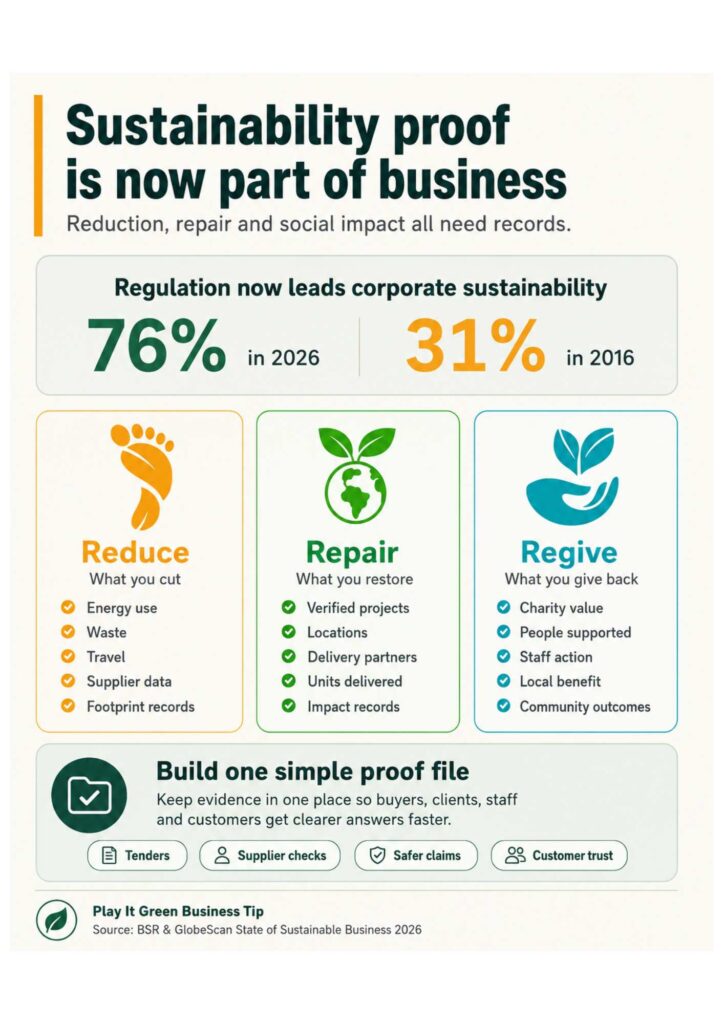
New BSR and GlobeScan research shows the shift clearly. Regulation is now the leading driver of corporate sustainability, cited by 76% of respondents in 2026, up from 31% in 2016, with customer and consumer demand rising from 21% to 44%. Sustainability has not stopped being commercial; it has become harder to prove badly.
For SMEs, sustainability regulation should not mean panic or a giant reporting project. It means getting the basics right before a tender, supplier form, buyer meeting or customer challenge lands. The businesses with clear records will have better answers than those trying to pull evidence together at the last minute.

Why Proof Is Becoming Commercial
Due to sustainability regulation, large companies are under more pressure to report what is happening across their supply chains. That pressure moves through suppliers, contractors, agencies, venues, manufacturers and service providers, all of which can become part of the wider evidence trail.
CDP says more than 270 major buyers requested data from around 45,000 suppliers through its Supply Chain programme in 2025, which shows how far supplier evidence has moved into mainstream procurement.
For smaller businesses, the request often arrives in a practical way. A procurement team asks for emissions information. A client wants to know what action has been taken. A tender asks about social value. A customer checks whether a claim on the website can be backed up. None of this needs to be dramatic, but it can affect who gets trusted, shortlisted or renewed.
Claims Need Better Evidence
The UK’s Green Claims Code (part of the wider sustainability regulation) says environmental claims should be truthful, clear, accurate and backed by evidence. The CMA has published guidance for claims made across supply chains, which matters when one company relies on information from suppliers, delivery partners or external projects.
This matters for words such as sustainable, low impact, climate friendly, nature positive or carbon neutral. The stronger the claim, the stronger the record needs to be. Under the new UK consumer regime, the CMA can fine companies up to 10% of global turnover for breaches of consumer protection law.
That does not mean businesses should stop talking about progress. It means the language should match the evidence, with energy cuts, waste reductions, supplier changes, nature repair and charitable giving backed by dates, numbers, records or verification.
Proof Has Three Parts
The useful way to think about sustainability regulation proof is reduction, repair and social impact. Reduction proof covers energy, waste, travel, purchasing choices, supplier questions, footprint data where available, and a reduction plan where a company has measured its emissions.
Repair proof covers the project type, location, delivery partner, date, verification method, units delivered and any nature or community outcomes that can be evidenced. Social impact proof covers charity value, people supported, staff action, local benefit, training, volunteering and contract-linked commitments.
Public procurement shows why this matters. UK PPN 002 mandates a minimum 10% weighting for social value in in-scope central government procurement, or an equivalent measure, which means social impact can directly influence scoring.
For Play It Green customers, education, verified nature repair and the 10% revenue giveback to good causes all create useful evidence. To help with sustainability regulation, these records should sit beside reduction work, showing what the business has learned, what it has repaired and what it has given back, without pretending that repair replaces emissions cuts.

A Simple Proof File
Most SMEs do not need a complicated system to start. A simple sustainability proof file can hold key records in one place, including bills, waste data, supplier replies, staff activity, nature repair records, charity giving, tender answers and approved wording for sales and marketing.
The aim is not perfection, but rather, the aim is to make the business easier to trust. A company with organised evidence can answer buyer questions faster, make safer claims, support tenders with less stress and show staff that the work is real.
Good proof can improve decisions too, as if a business tracks energy, waste, suppliers, repair and social impact, it can see where money is being saved, where risk is building, and where the story is strong enough to share.
Sustainability Regulation: Wrap-Up
Sustainability Regulation may sound like admin, but the commercial shift is proof. Businesses are being asked to show what they reduce, what they repair and what they give back, with records that support the words.
For SMEs, the next step is practical. Check the claims already being made, gather the evidence behind the work, ask suppliers better questions and keep reduction, repair and social impact records in one place. That is how regulation becomes useful, turning better evidence into lower risk, stronger trust and more value.
If you enjoyed the Sustainability Regulation article, why not become part of a community creating positive change by partnering with Play It Green and receive these tips weekly straight to your inbox? All whilst planting trees, mangroves and sea kelp and supporting a charity of your choice!
We help you reduce your footprint, repair the planet, and regive to social causes that matter, all through simple, measurable actions that aren’t hard to do.

Modern employees, consumers, and investors want to see impact, not promises. With Play It Green, your sustainability journey becomes visible, credible, and rewarding.
Join us today and turn good intentions into lasting results.